


New insights on why cats eat grass
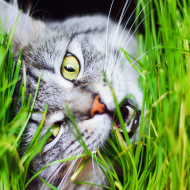
'...Regular, instinctive plant eating would have an adaptive role in maintaining a tolerable intestinal parasite load...'
Cats may eat grass due to an innate predisposition, passed down from their wild ancestors, a new survey of cat owners suggests.
Scientists from the University of California, Davis, carried out a survey of 1,021 cat owners who were able to observe their cat’s behaviour for three or more hours a day.
The findings were presented at the 53rd Congress of the International Society for Applied Ethology (5-9 August), which took place in Norway.
Seventy-one per cent of cats were seen eating plant matter at least six times, while 61 per cent did so more than 10 times. Only 11 per cent were never seen eating plants. Among the cats seen eating plants 10 times, 67 per cent were estimated to eat them daily or weekly.
The majority of respondents (91 per cent) said their cat almost always appeared normal before eating plants. However, 27 per cent said their cat vomited after eating plant material.
Scientists found that younger cats (aged three or under) were more likely to indulge in daily plant eating, compared to 27 per cent of cats aged four or above. Just 11 per cent of the younger cats were seen to frequently vomit after eating plants, compared to a significantly higher 30 per cent of older cats.
The research team said their findings are similar to those reported in dogs, but they do not support the popular theory that pets often eat grass to induce vomiting when they feel ill. Scientists said the findings also do not support the idea that young animals ‘learn’ plant eating from older animals.
Instead, the conclusion offered by the research team is that cats are innately predisposed to eating plants. There are numerous reports of regular plant eating in wild ancestors, which is mostly shown by the non-digestible grass and other plant parts seen in their scats. Studies of primates show that non-digestible plants purge the intestinal system of helminthic parasites.
Researchers concluded: ‘Given that virtually all wild carnivores carry an intestinal parasite load, regular, instinctive plant eating would have an adaptive role in maintaining a tolerable intestinal parasite load, whether or not the animal senses the parasites.’


 Companies marketing medicines for small pets exempt from authorisation must submit their annual return to the Veterinary Medicines Directorate (VMD) by 30 November 2026.



