
Your data on MRCVSonline
The nature of the services provided by Vision Media means that we might obtain certain information about you.
Please read our Data Protection and Privacy Policy for details.

In addition, (with your consent) some parts of our website may store a 'cookie' in your browser for the purposes of
functionality or performance monitoring.
Click here to manage your settings.
If you would like to forward this story on to a friend, simply fill in the form below and click send.

Your friend's email:
Your email:
Your name:
 
 
Send Cancel

First large-scale study of diabetic alert dogs published
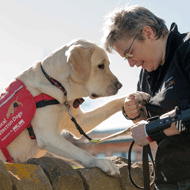
Medical alert dog Magic with handler Claire.
Detection dogs can 'significantly improve' quality of life for diabetic owners 

Specially trained alert dogs can detect 83 per cent of hypoglycaemic episodes in patients with diabetes, according to new research.

In the first large-scale study of its kind, researchers from the University of Bristol and the charity Medical Detection Dogs found that alert dogs have the potential to significantly improve quality of life for people with type 1 diabetes.

The team studied 27 trained glycaemia alert dogs, whose owners supplied six to 12 weeks’ worth of blood records – equating to more than 4,000 hypo- and hyper-glycaemic episodes – detailing each time the dog alerted.

Commenting on the results, which were published in PLOS ONE, Dr Nicola Rooney said: “Our research shows a dog’s effectiveness is affected by the individual dog and its connection with its human partner.

“Since the usage of such dogs is growing, it’s important that any dogs used for these purposes are professionally trained, matched and monitored by professional organisations like Medical Detection Dogs.  It’s also vital that research continues both to assess true efficacy and determine ways to optimise their performance.”

Medical Detection Dogs trains pet dogs to show alerting behaviours in response to the odour produced by human disease. In diabetic patients, dogs will alert when their owners’ blood sugar level falls too low, allowing them to take the appropriate action.

Image © Trevor Martin



Become a member or log in to add this story to your CPD history

Defra shares new Sanitary and Phytosanitary guidance

News Story 1
 Defra has published guidance for the vet sector ahead of a proposed UK-EU Sanitary and Phytosanitary agreement.

The agreement, which will change the movement and trade of animals and related products, could see reductions in checks, paperwork and certification. As well as describing regulatory developments, the advice highlights the importance of animal ID, registration and traceability in disease control and other compliance arrangements.

The guidance can be found here. More detail is expected as negotiations progress. 

Click here for more...
News Shorts
New form for online veterinary medicines retailers

The Veterinary Medicines Directorate (VMD) has produced a new online form for retailers wishing to sell veterinary medicines on the internet.

The form replace the previous Word version and is part of the VMD's ongoing commitment to digitise its processes. Anyone retailing prescription medicines online, including POM-V, POM-VPS and NFA-VPS categories, is lawfully required to register with the VMD before trading.

The change only applies to new applicants. Retailers already listed on the VMD's Register of Online Retailers or registered under the Accredited Internet Retailer Scheme (AIRS) do not need to do anything.


