


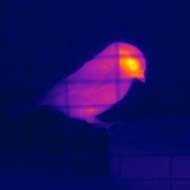
Technique avoids need for capture
Thermal imaging could transform the way biologists investigate responses of wild animals to environmental changes, according to new research.
Currently, researchers need to capture and measure animals in order to investigate their psychological state. But now a new study, led by the University of Glasgow, has allowed researchers to study animals without invasive sampling.
In challenging conditions, such as poor weather or food shortages, animals need to conserve their energy. One way they can achieve this is by reducing heat production. Such conditions also trigger a stress response in birds, which is associated with changes in blood flow and a reduced surface temperature.
In the study, researchers used thermal imaging to investigate a population of blue tits. They found that the region around the eye is cooler in birds in poor condition, as well as those with higher levels of stress hormone in their blood.
“These findings are important because understanding physiological processes is key to answering the questions of why animals behave the way they do, and how they interact with each other and their environment,” explained study author Dr Paul Jerem from the University of Glasgow.
“Changes in the physiological processes we detected using thermal imaging are generally the first response to environmental challenges. So being able to easily measure them in wild animals means we might be able to identify populations at risk before any decline takes place – a primary goal of conservation.”
Dr Dominic McCafferty, senior lecturer at the University’s Institute of Biodiversity, Animal Health and Comparative Medicine, added: “Current methods of investigating physiological state in free-living species still generally mean animals need to be trapped and handled, something which is difficult, potentially invasive, and limits research to those species which can be easily caught. Additionally, natural patterns of behaviour are also interrupted.”
“By looking at this promising alternative strategy - studying body temperature – we are using characteristics we can measure without invasive sampling to infer other underlying physiological processes.”
The study, ‘Eye region surface temperature reflects both energy reserves and circulating glucocorticoids in a wild bird’ is published in Scientific Reports.
Image (C) Paul Jerem


 The University of Glasgow is seeking participants for a new study into vet professionals nutrition-related knowledge, competence and decision-making.




