


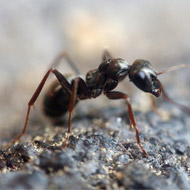
Research gives new insights into brain function
The navigational abilities of ants are more highly-developed than previously thought, according to new research.
A study led by the University of Edinburgh shows that ants use the sun’s position and visual memories to guide them back to the nest.
It was already established that ants use both methods. But researchers assumed they were two different reflexes that required ants to be facing in the direction of travel.
The study found that ants walking backwards will sometimes look behind to check their surroundings and set a course that is relative to the position the sun.
This shows that insects can find their way back to the nest, no matter what way they are facing.
“Ants have a relatively tiny brain, less than the size of a pinhead. Yet they can navigate successfully under many difficult conditions, including going backward,” explained co-author Professor Barbara Webb. “Understanding their behaviour gives us new insights into brain function, and has inspired us to build robot systems that mimic their functions.”
In the study, researchers analysed a colony of desert ants in Seville to see how insects navigate when transporting different sized bits of food. While ants normally walk forward when carrying small bits of food, they often drag larger items backwards.
The team sunk barriers into the ground to create a one-way route to the nest, before giving them either a small or large crumb of cookie. To make sure they stayed on track, the researchers found that the backward-walking ants would frequently drop the cookie and turn around.
They do this to compare what they see with their visual memories of the route, and correct their direction of travel if they have wandered off course.
Looking ahead, the team hope to ascertain the interplay between different regions in the ant’s brain that allows the insects to use and combine different forms of navigation.
The study is published in Current Biology.


 Veterinary practices are being urged to help owners safely dispose of any unused and expired pet medicines - not just antibiotics - during November's Animal Medicines Amnesty.



