
Your data on MRCVSonline
The nature of the services provided by Vision Media means that we might obtain certain information about you.
Please read our Data Protection and Privacy Policy for details.

In addition, (with your consent) some parts of our website may store a 'cookie' in your browser for the purposes of
functionality or performance monitoring.
Click here to manage your settings.
If you would like to forward this story on to a friend, simply fill in the form below and click send.

Your friend's email:
Your email:
Your name:
 
 
Send Cancel

Centre launches to fight East Coast fever disease
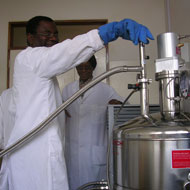
CTTBD scientist equipment for ECF vaccine production
CTTBD scientist using new equipment for ECF vaccine production.

Vaccine to be distributed in 11 African countries

A new centre for ticks and tick-borne diseases opened in Malawi last week to help fight East Coast fever (ECF) disease, which kills one cow every 30 seconds in Africa.

ECF is the single biggest cattle killer in 11 countries in Eastern and parts of Central Africa, where the disease is endemic. The Centre for Ticks and Tick-Borne Diseases (CTTBD) will deliver the "one shot for life" Mugaga cocktail vaccine. It will help protect 25 million cattle across the 11 countries.

"Tick-borne diseases are known to be one of the major constraining factors to the development of the livestock industry especially in Africa," said Dr Nkhwachi Gondwe, acting director of CTTBD. 

"We are launching CTTBD at the right time to enhance the prevention of ECF in the region in order to realise the potential of the livestock industry and to protect human lives and address poverty."

ECF has a devastating impact on the livelihoods of those who depend on their cattle. "Nearly 900 million people in Africa rely on livestock for their livelihoods," said Peter Jeffries, chief executive officer of the Global Alliance for Livestock Veterinary Medicines.

"When they lose livestock, they lose their source of livelihoods which trickles down to the entire economy. The vaccine being manufactured by CTTBD is a one-time vaccination, protecting cattle for their entire life and securing this vital source of livelihood."

Image courtesy of GALVmed

Become a member or log in to add this story to your CPD history

Defra shares new Sanitary and Phytosanitary guidance

News Story 1
 Defra has published guidance for the vet sector ahead of a proposed UK-EU Sanitary and Phytosanitary agreement.

The agreement, which will change the movement and trade of animals and related products, could see reductions in checks, paperwork and certification. As well as describing regulatory developments, the advice highlights the importance of animal ID, registration and traceability in disease control and other compliance arrangements.

The guidance can be found here. More detail is expected as negotiations progress. 

Click here for more...
News Shorts
BSAVA publishes fifth Manual of Canine and Feline Neurology

The BSAVA has published the fifth edition of its BSAVA Manual of Canine and Feline Neurology.

The new edition has been reviewed and updated, including new developments in diagnostics, therapeutic approaches and clinical decision-making. It is structured to support clinicians through diagnosis, treatment and long-term management.

The guide features five new chapters covering acute myelopathies, chronic myelopathies, emergency protocols, neurotoxicology and neuro-oncology.

It also includes over 100 videos, including demonstrations of neurological examinations, clinical presentations and diagnostic procedures.

Nicola Lloyd, publishing manager, said: "Whether you're a general practitioner seeking practical guidance, or a specialist aiming to refine your expertise, this edition remains an indispensable reference for anyone involved in the care of neurologically compromised dogs and cats."

