


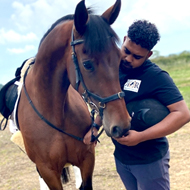
“On a horse, we’re all equal. There is no race, there is no gender, there is no class”.
A new campaign has been announced to raise awareness of inequality in the equestrian world.
The new 'Ride out Racism' campaign has been launched to facilitate change, tackle racial discrimination and encourage acceptance in the riding community.
It is the brainchild of 18-year-old Reece McCook from Coventry, who experienced racial discrimination in his equine education and employment, but also a great deal of support and encouragement.
Through the campaign, Reece hopes to use what he has experienced in his career to bring riding to more young people like him. He explained:
“Horses are amazing animals – they don’t judge who’s riding them, they’re incredibly tolerant and if you treat them with respect, they’ll love you back. And that should reflect equestrianism as a whole but sadly, at present, it’s not the case.
“There is work going on at the top to make improvements, British equestrian and equestrian bodies are driving for their equality standard for sport but it’s on the ground where we need to work harder.”
He continued: “Young people from urban environments, particularly those from minority ethnic groups, simply just don’t feel riding is a sport that’s for them. Cost, access to facilities and stereotypes are barriers. I was ashamed to tell my non-equestrian friends that I rode for fear of what they’d think about me but in reality, they were pretty cool about it and really intrigued. I want to make sure that none of these are barriers to taking part in future."
As part of the campaign, members of the riding community are encouraged to purchase ‘Ride out Racism’ rosettes and pin badges through Etsy and share pictures on social media. The profit made from each sale will be donated to organisations that are already working with young people from ethnic minorities and underprivileged backgrounds.
“‘Ride out Racism’ is just the first step for me, an initiative to raise awareness of inequality in the equestrian world, but I’d like to develop it into something where we can actually make a difference and help anyone experience riding and horses,” said Reece. “Getting new riders involved regardless of race, religion or background can only be beneficial for everyone.
“I need help to spread my message and challenge perceptions so we can effect change. If the campaign means all those in the equestrian world take a look at their own actions and behaviours and think how we can be more accepting and encouraging to all. “
He added: “On a horse, we’re all equal. There is no race, there is no gender, there is no class. But having the opportunity to get on a horse is beyond the reach of so many and it needn’t be. So, I’m asking everyone to support ‘Ride out racism’ as a start toward building a more diverse equestrian world where black faces are the normal, riding in hijab is standard and acceptance is automatic"
Image (C) BEF.


 Veterinary practices are being urged to help owners safely dispose of any unused and expired pet medicines - not just antibiotics - during November's Animal Medicines Amnesty.



