
Your data on MRCVSonline
The nature of the services provided by Vision Media means that we might obtain certain information about you.
Please read our Data Protection and Privacy Policy for details.

In addition, (with your consent) some parts of our website may store a 'cookie' in your browser for the purposes of
functionality or performance monitoring.
Click here to manage your settings.
If you would like to forward this story on to a friend, simply fill in the form below and click send.

Your friend's email:
Your email:
Your name:
 
 
Send Cancel

Dolphins ‘form friendships based on shared interests’
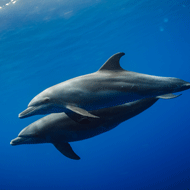
An international research team studied 124 male dolphins at Shark Bay. (Stock photo)
Study finds similarities in human and dolphin friendships 

New research suggests dolphins form friendships based on shared interests, in a similar way to humans.

An international research team studied 124 male dolphins at Shark Bay, a World Heritage area in Western Australia, which is home to an iconic population of Indo-Pacific bottlenose dolphins.

Shark Bay is the only place where dolphins have been observed using marine sponges as foraging tools, a learnt technique passed down from one generation to the next. It allows certain dolphins, known as ‘spongers’, to find food in deeper water channels.

Using behavioural, genetic and photographic data collected during the winter months over a nine-year period (2007-2015), the team analysed a sub-set of 37 male dolphins, comprising 13 spongers and 24 non-spongers.

They found that male spongers spent more time associating with other male spongers than non-spongers. These bonds were based on similar foraging techniques, not relatedness or other factors.

Co-author Dr Simon Allen, of the University of Bristol, said: "Foraging with a sponge is a time-consuming and largely solitary activity so it was long thought incompatible with the needs of male dolphins in Shark Bay – to invest time in forming close alliances with other males.

“This study suggests that, like their female counterparts and indeed like humans, male dolphins form social bonds based on shared interests.”

Manuela Bizzozzero, lead author of the study at the University of Zurich, added: "Male dolphins in Shark Bay exhibit a fascinating social system of nested alliance formation. These strong bonds between males can last for decades and are critical to each male’s mating success.

“We were very excited to discover alliances of spongers, dolphins forming close friendships with others with similar traits."

Become a member or log in to add this story to your CPD history

New RCVS Academy courses to remove barriers in vet care

News Story 1
 The RCVS Academy has launched two courses to its new client support series, as it seeks to improve accessibility in veterinary settings.

The courses will help professionals to support assistance dog partnerships and clients with hearing loss.

The Hearing loss and Assistance dogs courses saw RCVS project lead Catherine Hemingway collaborate with the British Deaf Association and Assistance Dogs UK. Vets will gain practical guidance on supporting clients with additional needs.

Each course takes an hour to complete, and can be accessed by RCVS registrants for free. 

Click here for more...
News Shorts
APHA launches free virtual work experience programme

The Animal and Plant Health Agency (APHA), in collaboration with Springpod, has launched a free virtual work experience programme, giving young people across the UK the chance to explore careers dedicated to protecting animal and plant health.

The on-demand programme offers a unique insight into career opportunities within APHA, showcasing how students can contribute to tackling some of the UK's most critical biosecurity and environmental challenges.

Designed for students aged 13 and over, the course includes more than 10 hours of engaging content featuring real-life industry insights, scenario-based challenges, and practical guidance on applying for jobs. To register for the course, visit the APHA website.

