Your data on MRCVSonline
The nature of the services provided by Vision Media means that we might obtain certain information about you.
Please read our Data Protection and Privacy Policy for details.

In addition, (with your consent) some parts of our website may store a 'cookie' in your browser for the purposes of
functionality or performance monitoring.
Click here to manage your settings.
If you would like to forward this story on to a friend, simply fill in the form below and click send.

Your friend's email:
Your email:
Your name:
 
 
Send Cancel

Study highlights risks of feeding a raw meat diet
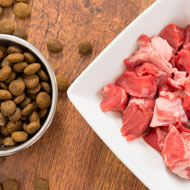
"The results obtained in this study show that it is highly important to handle RMBD carefully."
Raw dog foods found to contain high levels of bacteria

The potential health risks of raw meat-based diets (RMBD) to both animals and humans have been highlighted in a new study.

A paper published in Vet Record, concludes that dogs in families with young or immunocompromised individuals should not be fed RMBD, as these groups are more susceptible to infections.

In the study, researchers analysed frozen samples from 60 RMBD from 10 different manufacturers. According to the labels, the products originated from Sweden, Norway, Finland, Germany and the UK.

Unlike processed pet foods, the samples had not undergone any drying or heat treatment before freezing.

The researchers found that all 60 samples contained enterobacteria, with 31 of these samples exceeding the threshold set by EU regulations (5,000 bacteria per gram).

They also found that two of the samples contained levels of C.perfringens that exceeded the maximum level permitted by Swedish National Guidelines (5,000 bacteria per gram).

Furthermore, four of the samples contained salmonella - a figure that was higher than the researchers expected - and three of the samples contained campylobacter.

“The results obtained in this study show that it is highly important to handle RMBD carefully and to maintain good hygiene, due to the potential risks these feeds pose to human and animal health,” say the researchers.

“The RMBD should be kept frozen until used, thawing should take place at a maximum of 10°C and the thawed product should be separated from human food and handled with separate kitchen equipment, or with the equipment properly washed after use.”

The researchers note that dogs should not be fed RBMD while they are being treated with antimicrobials as this could increase the risk of resistant strains been selected and multiplying.

The study was carried out by researchers at the Swedish University of Agricultural Sciences and the Swedish National Veterinary Institute. 

Become a member or log in to add this story to your CPD history

Equine Disease Surveillance report released for Q4 2025

News Story 1
 The latest Equine Disease Surveillance report has been released, with details on equine disease from Q4 of 2025.

The report, produced by Equine Infectious Disease Surveillance, includes advice on rule changes for equine influenza vaccination.

Statistics and maps detail recent outbreaks of equine herpes virus, equine influenza, equine strangles and equine grass sickness. A series of laboratory reports provides data on virology, bacteriology, parasitology and toxicosis.

This issue also features a case study of orthoflavivus-associated neurological disease in a horse in the UK. 

Click here for more...
News Shorts
NSA webinar explores sheep tailing and castration

The National Sheep Association (NSA) is to host a free webinar on the castration and tail docking of lambs.

The webinar, 'Understanding the tailing and castration consultation: A guide for sheep farmers', will be hosted online on Monday, 2 March 2026 at 7.30pm.

It comes during a government consultation into the methods used for these procedures. Farmers are encouraged to engage before the consultation period closes on Monday, 9 March 2026.

The webinar offers clear and actionable guidance to support farmers to contribute meaningfully to the consultation and prepare for potential changes.

On the panel will be former SVS president Kate Hovers, farmer and vet Ann Van Eetvelt and SRUC professor in Animal Health and Veterinary Sciences Cathy Dwyer. Each panel member will utilise their own specialism and expertise to evaluate risks and outcomes to sheep farming.

Find out more about the webinar on the NSA website.