Your data on MRCVSonline
The nature of the services provided by Vision Media means that we might obtain certain information about you.
Please read our Data Protection and Privacy Policy for details.

In addition, (with your consent) some parts of our website may store a 'cookie' in your browser for the purposes of
functionality or performance monitoring.
Click here to manage your settings.
If you would like to forward this story on to a friend, simply fill in the form below and click send.

Your friend's email:
Your email:
Your name:
 
 
Send Cancel

Wildcat population ‘no longer viable’ in Scotland
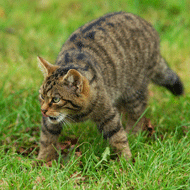
Hybridisation, where wildcats breed with feral or domestic cats, is a major threat to the species.

Cat owners ‘have an important role’ in reversing declines

There is no longer a viable wildcat population living in Scotland, according to a review of the evidence by members of the IUCN.

Previous studies have shown that hybridisation - where wildcats breed with feral or domestic cats - is a major threat to the species. Limited food sources and persecution are thought to have prompted the few remaining wildcats to breed with domestic cats.

Steps are now underway to bring the species back from the brink, including a potential release programme of captive-bred animals and a National Wildlife Reintroduction Centre.

Scottish Natural Heritage said a national conversation is needed on how to manage domestic and feral cat populations.

“The public will have an important role in helping minimise future hybridisation,” said head of policy and advice, Eileen Stuart. “Responsible cat ownership - including microchipping, neutering and vaccinations - is one way we can help reduce the devastating effects on wildcats.”

Dr Andrew Kitchener, steering group chair for Scottish Wildcat Action (SWA), added: “We now have the strongest and most reliable evidence to date that wildcats are in a more endangered state than previously understood.

“While we believe there are wildcats remaining in the wild in Scotland, there are no longer enough to ensure their continued survival as viable populations. We can now plan the essential next steps to give the wildcat a sustainable future.”

SWA’s project partner, the Royal Zoological Society of Scotland, is working with a range of organisations on a series of measures to reverse the declines.

Scottish cabinet secretary Roseanna Cunningham said she will “consider every possible action the Scottish Government can take to save [the species]”.

Image by Peter Trimming/Wikimedia Commons/CC BY 2.0

 

Become a member or log in to add this story to your CPD history

Equine Disease Surveillance report released for Q4 2025

News Story 1
 The latest Equine Disease Surveillance report has been released, with details on equine disease from Q4 of 2025.

The report, produced by Equine Infectious Disease Surveillance, includes advice on rule changes for equine influenza vaccination.

Statistics and maps detail recent outbreaks of equine herpes virus, equine influenza, equine strangles and equine grass sickness. A series of laboratory reports provides data on virology, bacteriology, parasitology and toxicosis.

This issue also features a case study of orthoflavivus-associated neurological disease in a horse in the UK. 

Click here for more...
News Shorts
NSA webinar explores sheep tailing and castration

The National Sheep Association (NSA) is to host a free webinar on the castration and tail docking of lambs.

The webinar, 'Understanding the tailing and castration consultation: A guide for sheep farmers', will be hosted online on Monday, 2 March 2026 at 7.30pm.

It comes during a government consultation into the methods used for these procedures. Farmers are encouraged to engage before the consultation period closes on Monday, 9 March 2026.

The webinar offers clear and actionable guidance to support farmers to contribute meaningfully to the consultation and prepare for potential changes.

On the panel will be former SVS president Kate Hovers, farmer and vet Ann Van Eetvelt and SRUC professor in Animal Health and Veterinary Sciences Cathy Dwyer. Each panel member will utilise their own specialism and expertise to evaluate risks and outcomes to sheep farming.

Find out more about the webinar on the NSA website.