Your data on MRCVSonline
The nature of the services provided by Vision Media means that we might obtain certain information about you.
Please read our Data Protection and Privacy Policy for details.

In addition, (with your consent) some parts of our website may store a 'cookie' in your browser for the purposes of
functionality or performance monitoring.
Click here to manage your settings.
If you would like to forward this story on to a friend, simply fill in the form below and click send.

Your friend's email:
Your email:
Your name:
 
 
Send Cancel

ZSL publishes list of threatened reptiles
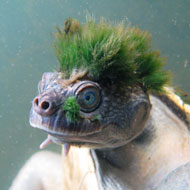
The Mary River turtle is ranked at number 30 on the reptile EDGE list.

Madagascar big-headed turtles top the EDGE list 

The Zoological Society of London (ZSL) has published a list of reptiles that are heading for extinction unless urgent action is taken, in a bid to help focus conservation efforts.

Madagascar big-headed turtles topped the list of 100 Evolutionarily Distinct and Globally Endangered (EDGE) reptiles.

Other species included on the list include the world’s largest sea turtle, the leatherback, at number 85; the Mary River turtle at number 30 and the gharial, a freshwater crocodile that was once common across much of Asia, but is now confined to a handful of rivers in northern India and Nepal.

ZSL first established lists of evolutionarily distinct and globally endangered (EDGE) species in 2007. Lists were previously created for amphibians, birds, corals and mammals, but now attention has turned to reptiles.

The latest ranking highlights 100 species that are a conservation priority. Each species is given an EDGE score based on the risk of extinction and how isolated or unusual that species is on the ‘tree of life’.

The reptile list is backed by a study published in PLOS ONE.

Commenting on the findings, ZSL’s EDGE of Existence programme manager, Dr Nisha Owen, said: “When EDGE launched in 2007, our vision was to shine a light on those species that, if they were allowed to go extinct, would effectively take an entire branch of the Tree of Life with them.

“Over the intervening decade, our EDGE Fellows have worked to save everything from pangolins and echidnas, to the Chinese giant salamander and Philippine Eagle.

“We’re delighted to now be expanding the programme to embrace reptiles as well, highlighting a whole additional class of Evolutionarily Distinct and Globally Endangered wildlife while also empowering a new generation of field conservationists striving worldwide to secure their protection.”

Image © ZSL Chris Van Wyk

Become a member or log in to add this story to your CPD history

Equine Disease Surveillance report released for Q4 2025

News Story 1
 The latest Equine Disease Surveillance report has been released, with details on equine disease from Q4 of 2025.

The report, produced by Equine Infectious Disease Surveillance, includes advice on rule changes for equine influenza vaccination.

Statistics and maps detail recent outbreaks of equine herpes virus, equine influenza, equine strangles and equine grass sickness. A series of laboratory reports provides data on virology, bacteriology, parasitology and toxicosis.

This issue also features a case study of orthoflavivus-associated neurological disease in a horse in the UK. 

Click here for more...
News Shorts
NSA webinar explores sheep tailing and castration

The National Sheep Association (NSA) is to host a free webinar on the castration and tail docking of lambs.

The webinar, 'Understanding the tailing and castration consultation: A guide for sheep farmers', will be hosted online on Monday, 2 March 2026 at 7.30pm.

It comes during a government consultation into the methods used for these procedures. Farmers are encouraged to engage before the consultation period closes on Monday, 9 March 2026.

The webinar offers clear and actionable guidance to support farmers to contribute meaningfully to the consultation and prepare for potential changes.

On the panel will be former SVS president Kate Hovers, farmer and vet Ann Van Eetvelt and SRUC professor in Animal Health and Veterinary Sciences Cathy Dwyer. Each panel member will utilise their own specialism and expertise to evaluate risks and outcomes to sheep farming.

Find out more about the webinar on the NSA website.