


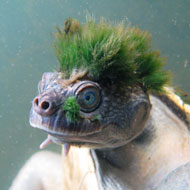
Madagascar big-headed turtles top the EDGE list
The Zoological Society of London (ZSL) has published a list of reptiles that are heading for extinction unless urgent action is taken, in a bid to help focus conservation efforts.
Madagascar big-headed turtles topped the list of 100 Evolutionarily Distinct and Globally Endangered (EDGE) reptiles.
Other species included on the list include the world’s largest sea turtle, the leatherback, at number 85; the Mary River turtle at number 30 and the gharial, a freshwater crocodile that was once common across much of Asia, but is now confined to a handful of rivers in northern India and Nepal.
ZSL first established lists of evolutionarily distinct and globally endangered (EDGE) species in 2007. Lists were previously created for amphibians, birds, corals and mammals, but now attention has turned to reptiles.
The latest ranking highlights 100 species that are a conservation priority. Each species is given an EDGE score based on the risk of extinction and how isolated or unusual that species is on the ‘tree of life’.
The reptile list is backed by a study published in PLOS ONE.
Commenting on the findings, ZSL’s EDGE of Existence programme manager, Dr Nisha Owen, said: “When EDGE launched in 2007, our vision was to shine a light on those species that, if they were allowed to go extinct, would effectively take an entire branch of the Tree of Life with them.
“Over the intervening decade, our EDGE Fellows have worked to save everything from pangolins and echidnas, to the Chinese giant salamander and Philippine Eagle.
“We’re delighted to now be expanding the programme to embrace reptiles as well, highlighting a whole additional class of Evolutionarily Distinct and Globally Endangered wildlife while also empowering a new generation of field conservationists striving worldwide to secure their protection.”
Image © ZSL Chris Van Wyk


 Veterinary practices are being urged to help owners safely dispose of any unused and expired pet medicines - not just antibiotics - during November's Animal Medicines Amnesty.



