Your data on MRCVSonline
The nature of the services provided by Vision Media means that we might obtain certain information about you.
Please read our Data Protection and Privacy Policy for details.

In addition, (with your consent) some parts of our website may store a 'cookie' in your browser for the purposes of
functionality or performance monitoring.
Click here to manage your settings.
If you would like to forward this story on to a friend, simply fill in the form below and click send.

Your friend's email:
Your email:
Your name:
 
 
Send Cancel

US technician builds equine CT table
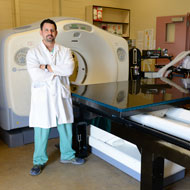
Mr Peters worked with a carbon fibre manufacturer that specialises in automotive parts.

Innovative design makes scanning equines less complicated 

US veterinary technician Jason Peters has developed a new, state-of-the-art CT table for large animal patients, to overcome difficulties scanning equines.

Performing a CT scan on a horse previously required a team of nearly a dozen technicians and veterinary surgeons, in addition to forklifts and cranes. The previous CT table at UC Davis School of Veterinary Medicine had been in use for three decades, but when they began looking for a new large animal table, it became apparent that they could not purchase a pre-built table due to the room configuration.

After discussing materials that could be used for the project, the team settled on carbon fibre - a new-age material that can be folded to take any shape and strength. It is used in many applications in NASA’s space program because of its strength-to-weight ratio, high stiffness, chemical resistance and temperature tolerance. The material is also used in sports cars such as Ferraris and Lamborghinis, as well as motorcycles, bicycles and sail boats.

However, moulding the material correctly is crucial for ensuring its strength. Mr Peters worked with a carbon fibre manufacturer that specialises in automotive parts, using plans developed with the UC Davis College of Engineering. Together, they created a table that weighs just 100lb, but can take up to 10,000lb in any area. The old table weighs nearly twice as much and is not nearly as strong, according to the university.

Additionally, the horse can remain stationary and the new table can be moved into position if, for example, the horse needed its front and hind legs scanned. Previously, technicians would have had to physically reposition the horse.

Extension plates were also made to provide an extra surface for anatomy that does not fit on the main table. 

Photo courtesy of UC Davis

Become a member or log in to add this story to your CPD history

Equine Disease Surveillance report released for Q4 2025

News Story 1
 The latest Equine Disease Surveillance report has been released, with details on equine disease from Q4 of 2025.

The report, produced by Equine Infectious Disease Surveillance, includes advice on rule changes for equine influenza vaccination.

Statistics and maps detail recent outbreaks of equine herpes virus, equine influenza, equine strangles and equine grass sickness. A series of laboratory reports provides data on virology, bacteriology, parasitology and toxicosis.

This issue also features a case study of orthoflavivus-associated neurological disease in a horse in the UK. 

Click here for more...
News Shorts
NSA webinar explores sheep tailing and castration

The National Sheep Association (NSA) is to host a free webinar on the castration and tail docking of lambs.

The webinar, 'Understanding the tailing and castration consultation: A guide for sheep farmers', will be hosted online on Monday, 2 March 2026 at 7.30pm.

It comes during a government consultation into the methods used for these procedures. Farmers are encouraged to engage before the consultation period closes on Monday, 9 March 2026.

The webinar offers clear and actionable guidance to support farmers to contribute meaningfully to the consultation and prepare for potential changes.

On the panel will be former SVS president Kate Hovers, farmer and vet Ann Van Eetvelt and SRUC professor in Animal Health and Veterinary Sciences Cathy Dwyer. Each panel member will utilise their own specialism and expertise to evaluate risks and outcomes to sheep farming.

Find out more about the webinar on the NSA website.