
Your data on MRCVSonline
The nature of the services provided by Vision Media means that we might obtain certain information about you.
Please read our Data Protection and Privacy Policy for details.

In addition, (with your consent) some parts of our website may store a 'cookie' in your browser for the purposes of
functionality or performance monitoring.
Click here to manage your settings.
If you would like to forward this story on to a friend, simply fill in the form below and click send.

Your friend's email:
Your email:
Your name:
 
 
Send Cancel

Study reveals how cows indicate feelings using their ears
cow
"Understanding animal emotions is crucial if we are to improve animal welfare as emotions play a major role in an animal’s mental well-being."

Understanding emotions crucial to improving animal welfare

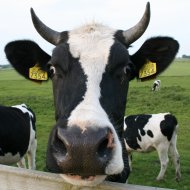
New research into how to measure the emotional state of cows has suggested that it may be possible to tell how a cow is feeling from the position of its ears. It also reveals that, like our pets, cows display visible signs of pleasure at being stroked.

Nearly 400 observations of 13 cows were taken by scientists at leading animal welfare charity World Animal Protection.

The study showed that when cows were stroked for five minutes, an experience that put the cows into a calm and relaxed state, the cows performed either a backward ear posture or a hanging ear posture, where the ear fell loosely, perpendicular to the head. This contrasts with the more usual position of the ear before and after stroking of either upright or forwards.

Previous studies have suggested that ear position may provide clues to how sheep and pigs are feeling, however this is the first study to look at whether cows display similar traits.

Helen Proctor from World Animal Protection said: “Although these results need further validation using different stimuli, they do indicate that the use of ear postures may provide a quick, non-invasive and low-cost measure to assess the emotional state of dairy cows.
 
“Because emotions are defined as short lasting, it is possible that ear postures may provide both an immediate indicator of the cow’s emotional state and may also be indicative of a longer lasting mood state. 

"Understanding animal emotions is crucial if we are to improve animal welfare as emotions play a major role in an animal’s mental well-being. Research into positive emotions must therefore continue, and reliable indicators of positive emotions need to be developed and applied in practice so that animal welfare can continue to improve.”

It is hoped that the study will be of use to the dairy industry in their programmes and understanding of their cows. 

Can ear postures reliably measure the positive emotional state of cows? is published in Applied Animal Behaviour. 

Become a member or log in to add this story to your CPD history

FIVP publishes CMA Compliance Checklist

News Story 1
 FIVP has published a CMA Compliance Checklist to support independent practices with the Market Investigation Order.

The document includes deadlines for small and large businesses, with tick boxes for each of the tasks. The organisation also invites practices to contact them for support with requirements.

Rita Dingwall, FIVP chair, said: FIVP appreciates that navigating the new CMA requirements can feel daunting. We hope this checklist will make things a little easier, helping independent practices work through what is required with confidence. 

Click here for more...
News Shorts
APHA launches free virtual work experience programme

The Animal and Plant Health Agency (APHA), in collaboration with Springpod, has launched a free virtual work experience programme, giving young people across the UK the chance to explore careers dedicated to protecting animal and plant health.

The on-demand programme offers a unique insight into career opportunities within APHA, showcasing how students can contribute to tackling some of the UK's most critical biosecurity and environmental challenges.

Designed for students aged 13 and over, the course includes more than 10 hours of engaging content featuring real-life industry insights, scenario-based challenges, and practical guidance on applying for jobs. To register for the course, visit the APHA website.

