
Your data on MRCVSonline
The nature of the services provided by Vision Media means that we might obtain certain information about you.
Please read our Data Protection and Privacy Policy for details.

In addition, (with your consent) some parts of our website may store a 'cookie' in your browser for the purposes of
functionality or performance monitoring.
Click here to manage your settings.
If you would like to forward this story on to a friend, simply fill in the form below and click send.

Your friend's email:
Your email:
Your name:
 
 
Send Cancel

Microchip reminder after giant tortoise found wandering through field
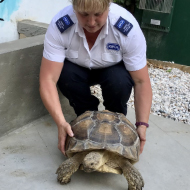
RSPCA animal collection officer Kate Wright with the runaway tortoise.

Finder hauled the enormous animal home in a wheelbarrow

Pet owners are being reminded to ensure their animals are microchipped after a giant sulcata tortoise was found wandering through a field in Hertfordshire.

The tortoise was found by a woman out walking her dog and had to be hauled home in a wheelbarrow owing to its enormous size.

RSPCA animal collection officer Kate Wright, who was called out to the incident, discovered the tortoise wasn’t microchipped. The incident is one of 952 involving tortoises reported to the charity each year. 

“We’d always encourage tortoise owners to get their pets microchipped and to ensure they are kept in a secure enclosure,” Kate added. “While many people think of tortoises as being slow they’re actually quite active and can move at quite a pace when they want to.

“Tortoises also climb, dig and can push their way through barriers so can be good escape artists. We receive almost 1,000 calls every year about tortoises, many of which have escaped from their homes and gone on the run!”

The sulcata tortoise - which can weigh more than 100kg and grow to be up to 80cm long - was eventually reunited with his owner who was advised to get him microchipped.

RSPCA senior scientific officer in exotics and wildlife trade Dr Stephanie Jayson said: “We hear stories like these all too often and our officers are regularly called to collect stray tortoises and escaped pets.

“Tortoise owners often let their pets out in the garden during the summer weather and tortoises can become very active in the warm temperatures and sunshine. It’s really important that owners keep a close eye on their pets when outside or have a secure run to keep them in to keep them safe from other animals, and to ensure they can’t escape.”

Image (C) RSPCA.

Become a member or log in to add this story to your CPD history

Equine Disease Surveillance report released for Q4 2025

News Story 1
 The latest Equine Disease Surveillance report has been released, with details on equine disease from Q4 of 2025.

The report, produced by Equine Infectious Disease Surveillance, includes advice on rule changes for equine influenza vaccination.

Statistics and maps detail recent outbreaks of equine herpes virus, equine influenza, equine strangles and equine grass sickness. A series of laboratory reports provides data on virology, bacteriology, parasitology and toxicosis.

This issue also features a case study of orthoflavivus-associated neurological disease in a horse in the UK. 

Click here for more...
News Shorts
NSA webinar explores sheep tailing and castration

The National Sheep Association (NSA) is to host a free webinar on the castration and tail docking of lambs.

The webinar, 'Understanding the tailing and castration consultation: A guide for sheep farmers', will be hosted online on Monday, 2 March 2026 at 7.30pm.

It comes during a government consultation into the methods used for these procedures. Farmers are encouraged to engage before the consultation period closes on Monday, 9 March 2026.

The webinar offers clear and actionable guidance to support farmers to contribute meaningfully to the consultation and prepare for potential changes.

On the panel will be former SVS president Kate Hovers, farmer and vet Ann Van Eetvelt and SRUC professor in Animal Health and Veterinary Sciences Cathy Dwyer. Each panel member will utilise their own specialism and expertise to evaluate risks and outcomes to sheep farming.

Find out more about the webinar on the NSA website.

