


Pet python ingests BBQ tongs

"Not surprisingly the gastrointestinal tract in this animal was greatly distended by the foreign body and the end of the tongs could actually be seen through distended viscera," said vet Oliver Funnell.
A pet python that ingested a pair of barbecue tongs is said to be recovering well after vets in Australia operated to remove the implement.
Two-year-old Woma python Winston grabbed hold of the tongs along with the thawed rat his owner was trying to feed him. Attempts to retrieve the implement were not successful and, much to his owner's shock, Winston ingested the tongs along with his meal.
Winston was taken to see Oliver Funnell, a vet at the University of Adelaide's Companion Animal Health Centre, which sees mainly cat and dog cases.
 Woma python Winston grabbed the tongs along with the thawed rat his owner was feeding him.
"From Aaron's reaction I could tell that I was about to see something unusual…" Oliver commented.
"On opening the box the relatively small snake had a very large swelling, the skin and muscles had constricted around the object and the outline was well defined. Through the skin you could feel the bumps on the end of the tongs and at the other end the relatively square hinge could be seen obviously protruding through abdominal wound."
Winston was given a pre-anaesthetic opiod analgesic (Butorphanol) and a dissociative anaesthetic (Ketamine) to allow vets to pass an endotracheal tube into the trachea. As these are not made small enough for snakes, a 14 gauge plastic intravenous catheter was used instead.
Once the tube was in place, Winston was ventilated with a mixture of oxygen and anaesthetic (isoflurane). Heat mats were used to maintain body temperature and anaesthesia was monitored using a Doppler probe on the heart, pulse oximetry on the tail and moving and pinching the tail to assess anaesthesia and muscle relaxation.
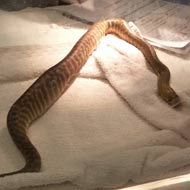
Winston pre-op: "The relatively small snake had a very large swelling, the skin and muscles had constricted around the object and the outline was well defined."
"By the position of the other organs we deduced that the object was likely lodged in the caudal oesophagus and stomach but with everything so distended it was difficult to be sure.
"Incising over the larger end of the tongs allowed them to be removed easily and with sutures to hold the incision open we could stop the rest of the abdominal cavity from being contaminated by any of the gut contents."
Winston was given post-operative analgesics and antibiotics and his sutures will be removed after four weeks, as reptiles have slower healing times. At his follow up appointment, Winston was behaving normally and has been seen drinking. He will not need to be fed again for two to four weeks.


 A nationwide roadshow offering free, personalised parasite risk assessments and flea and tick checks will be visiting popular dog events across the UK.



