


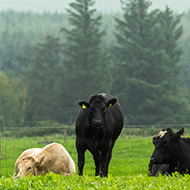
New model assesses how woodland-planting subsidies might affect deer populations.
The potential spread of infection amongst wildlife and livestock should be considered when expanding woodland, new research suggests.
The study by the Roslin Institute suggests that careful planning is vital when designing environmental policies, such as woodland management schemes, to control the risk of disease transmission.
Researchers developed an economic data model to explore how woodland-planting subsidies might affect deer populations, landscapes, and the proximity of wildlife to cattle farms.
Focusing on south-west Scotland, the team modelled a range of woodland expansion scenarios and found that connectivity between deer habitat and cattle grazing could increase by up to 35 per cent, possibly accelerating disease transmission.
Published in the Journal of Environmental Management, the study specifically examined the possible implications for the spread of bovine tuberculosis. However, the researchers note that the model could be applied to any infectious disease that passes between livestock and wildlife.
Dr Chris Banks, a core scientist at The Roslin Institute, said: “Woodland expansion brings many benefits, including biodiversity gains and carbon sequestration, but it is important to understand any unintended consequences for livestock disease risk.
“Our work suggests there is value in considering where woodland is planted, so that environmental goals can be achieved while minimising the potential for increased contact between wildlife and farmed cattle.”
Image (C) Alex Konon/Shutterstock.com


 Defra has published guidance for the vet sector ahead of a proposed UK-EU Sanitary and Phytosanitary agreement.



