


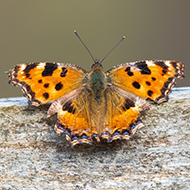
The species had been classed as extinct in the UK for over 30 years.
A butterfly classed as extinct in the UK for more than 30 years has been spotted in the south of England.
Once common across England and Wales, the large tortoiseshell was last recorded as a resident, breeding species in the UK in the 1980s.
In the past two weeks, however, members of the public have captured photographs of the species in Kent, Hampshire, Sussex, Dorset, Cornwall and the Isle of Wight.
The charity Butterfly Conservation states that if it were to update its official endangered species list tomorrow, it would likely class the Large Tortoiseshell as no longer extinct.
Professor Richard Fox said: "This is great news about a beautiful and charismatic butterfly: if the individuals that are being seen can survive and reproduce, then there's no downside to the large tortoiseshell coming back, and we can look at what we might be able to do to help it."
The large tortoiseshell is a big, colourful butterfly with orange, black and blue wings. It is a close relation of the small tortoiseshell but has different markings.
Adults primarily lay their eggs on elm trees, and the population crash has been linked to the spread of Dutch elm disease across Europe in the 20th century.
In recent years, however, there has been significant growth in the large tortoiseshell population in the Netherlands - and ecologists believe an increasing number might be flying across the sea to England.
Butterfly Conservation added the species to its First Sightings web page last week.
The first reported sighting of a large tortoiseshell was on the Isle of Wight on 24 February. Members of the public have also reported at least 20 more sightings on the Isle of Wight, in Kent and Hampshire.
Image (C) Stephan Morris/Shutterstock.

 The latest



