


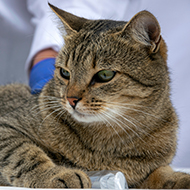
The drug targets the transcription factor STAT 3.
Researchers at the University of California have conducted the first-ever clinical trial of a new class of targeted therapy for pet cats with head and neck squamous cell carcinoma (HNSCC).
The drug, which is the first to target the transcription factor STAT3, showed promising results, and is likely to be effective for humans with the disease.
Writing in the journal Cell Press, researchers describe how 35 per cent of cats in the study had their disease controlled with minimal side effects. Among them was a nine-year-old black domestic shorthair named Jak, who lived eight months after his diagnosis, and much longer than expected.
Jak’s owner, Tina Thomas, said: “It was meaningful to us because he was here in our lives. During that time, my son finished college and my daughter finished her master’s program. Jak got to spend one more Christmas with us, and he loved our Christmas tree. He was worth every bit of the effort.”
Interestingly, researchers believe conducting clinical trials in pets could be a better model of how drugs work in humans, compared with lab mice. The team is currently working with a small biotech firm to advance the treatment in clinical trials for pets and humans.
First author Jennifer Grandis, said: “This study is a great example of how we can think more carefully about spending our very limited resources on studies in lab mice that are not even the best models of human cancers.
“By partnering with veterinary oncologists and doing clinical trials in companion animals, we can learn an enormous amount about how these drugs work while also helping people’s pets. None of the cats in these trials were harmed, and many of them benefited.”
Image (C) Shutterstock.


 Eligible members of BEVA will be able to vote for their Council team until Monday, 17 August 2026. Members will have received an election email on 17 July.



