


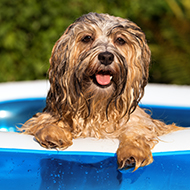
The simple technique can help dogs cool down rapidly after exercise.
Training dogs to voluntarily dunk their heads in water after exercise is the most effective way to cool them down, according to a new study.
Researchers at the Penn Vet Working Dog Centre, University of Pennsylvania, found the method not only cools dogs quicker than other techniques but also prevents dangerous post-exercise temperature spikes.
The finding is being hailed as a 'game changer' for dog owners and handlers, particularly in situations when access to large quantities of water is scarce.
Dr Cynthia M. Otto, lead author of the study and executive director of the Penn Vet Working Dog Centre, believes the finding alters our understanding of cooling methods in the dog.
“During heat stress, blood flow to the head, nose, tongue and ears is increased. Cooling the tissues of the head allows for rapid cooling of the whole body with limited amounts of water. Furthermore, training the dog to participate in the cooling process can enhance not only its safety but the human-animal bond.”
In the study, researchers used positive reinforcement training to encourage and reward dogs for dunking their heads in a bucket of clean, room-temperature water to retrieve a treat or toy. The water was added gradually until the dogs were comfortable immersing their heads.
Researchers hope that by training dogs to perform this task, owners can provide rapid relief from overheating and additionally flush their eyes and nose of dust and debris – making it a valuable first aid technique.
The paper, Voluntary head dunking after exercise-induced hyperthermia rapidly reduces core body temperature in dogs, is published in The Journal of the American Veterinary Association.
Image (C) Shutterstock.


 Veterinary practices are being urged to help owners safely dispose of any unused and expired pet medicines - not just antibiotics - during November's Animal Medicines Amnesty.



