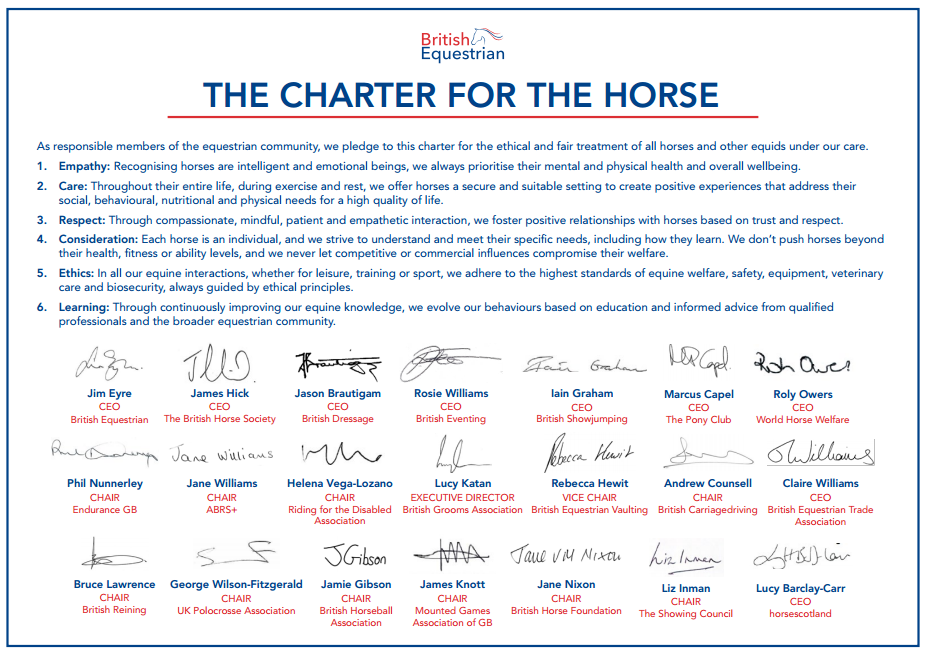
Equine groups sign new welfare charter
World Horse Welfare, The British Horse Society, and British Showjumping are among the organisations which have signed the charter.
The 19 member bodies of British Equestrian (BEF) and associated industry leaders have signed a new horse welfare charter.
Those signing the Charter for the Horse pledge to treat all equids in their care in an ethical and fair way to ensure their welfare and wellbeing. Six areas are covered: empathy, care, respect, consideration, ethics, and learning.
The charter, created by the BEF, was inspired by the work of the Fédération Équestre Internationale’s (FEI’s) Equine Ethics and Wellbeing Commission (EEWC), which published the FEI Equestrian Charter in April 2023.
While that charter is aimed at those involved in international equestrian sport, the BEF charter is aimed at anyone who interacts with horses in the UK.
As well as producing the charter, the BEF’s board and Equine Wellbeing and Ethics Advisory Group (EWEAG), chaired by Madeleine Campbell, have been working on extensive revisions of the BEF’s rule book and Equine Ethics and Welfare Policy.
The proposed revisions are set to be reviewed in consultation with member bodies and the rule book is planned to be published in 2025
Jim Eyre, BEF chief executive, said: “In our privileged position to live and work with horses, we must champion the very best standards and excellence levels for their welfare – it’s non-negotiable, and the support for bringing this overarching Charter for the Horse to fruition has been outstanding.
“There’s been a real passion and sense of determination to make it happen and now we look forward to working with our member bodies, their members and the wider British equestrian community to upholding the charter, with equine welfare at the fore of all activity.”
Prof Campbell added; “As chair of the EWEAG, I am delighted that British Equestrian and its member bodies are leading the world in implementing the recommendations of FEI’s EEWC at national level. Such proactive, collaborative sharing of responsibility across disciplines and uses is just what we need to safeguard the welfare of horses from elite to grassroots levels of equestrianism.”
Image © British Equestrian


 Defra has published guidance for the vet sector ahead of a proposed UK-EU Sanitary and Phytosanitary agreement.