


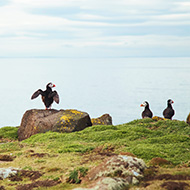
The Isle of May and Noss National Nature Reserves are home to hundreds of breeding seabirds.
Scotland's nature agency is closing two of its nature reserves in a bid to protect vulnerable seabirds from avian influenza.
NatureScot's Isle of May reserve, Firth of Forth, and Noss National Nature Reserve (NNRs), Shetland, are home to hundreds of breeding seabirds.
The reserves will be closed from 1 July in response to concerns over the spread and impact of the H5N1 strain of avian flu.
NatureScot said that visitors can still enjoy the summer seabird spectacle at a distance and by taking round-island boat trips without coming ashore.
Eileen Stuart, NatureScot’s deputy director of nature and climate change, said the decision to close the reserves had not been taken lightly.
“We are increasingly concerned about the devastating impact avian flu is having in Scotland, particularly on our seabird colonies,” she said.
"The situation has been rapidly evolving and deteriorating, and we feel at this time that restricting access to these sites, and reducing it at others, is a precautionary but proportionate approach that gives us the best chance of reducing the spread of the virus and its impact.”
She added: “We recognise that this will be disappointing for those planning a visit but we hope people understand that this is about protecting our precious seabird populations for the future. We will be keeping the situation under regular review over the coming weeks.”
Avian flu is widespread across Scotland, with positive cases recorded in Shetland, Orkney, St Kilda, Lewis and St Abbs.
Great skua and gannets have been hardest hit by the virus, with research showing a 64 per cent decline of great skua on St Kilda and 85 per cent at Rousay in Orkney.
Arctic tern, common guillemot and puffin have also tested positive.


 Veterinary practices are being urged to help owners safely dispose of any unused and expired pet medicines - not just antibiotics - during November's Animal Medicines Amnesty.



