


RCVS Council votes for temporary OV registration
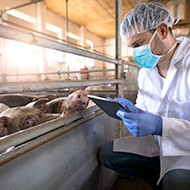
Defra expects a 'severe shortage' of OV capacity in abattiors in England and Wales.
At an RCVS Council meeting yesterday (9 June), the Council unanimously voted to continue temporary registration of non-UK European veterinary surgeons as Official Veterinarians (OVs).
The request to allow the temporary registration came from the Food Standards Agency (FSA), who submitted a similar request in March 2021, allowing non-UK European veterinary surgeons to fulfil meat hygiene tasks in abattoirs for a year.
Requesting the temporary registration for a further year, the FSA proposed: “We ask that the RCVS admit to its temporary register, vets who (i) have a contract of employment to work as an OV providing meat hygiene controls in England and Wales; (ii) have the necessary skilled worker visa including IELTS at level 5; and (iii) hold European Association of Establishments for Veterinary Education (EAEVE) accredited veterinary degrees and iv) have completed and passed the meat OV training course.
“The FSA would then authorise them as an OV on confirmation of their status as a temporary registrant.”
At the meeting, director of veterinary services at the FSA, Jane Clark assured the Council that standards are high, and that 104 temporary registrants are currently working as OVs, with most of them on track to achieve full RCVS registration within a year.
Voting on the motion, the RCVS Council agreed to an extension of 12 months, after which it will be subject to another council vote. Under the agreement, the temporary registration will be reviewed jointly by Defra, the Welsh government, the FSA and the RCVS after six months.
Speaking on its Twitter platform, the FSA said: “We are delighted that the RCVS agreed to extend Temporary Registration.
“This decision will continue to allow appropriately qualified veterinarians with Level 5 English to temporarily register (TR) with the RCVS and work as Temporary Registered Novice Official Veterinarians (TRNOV).
“This will allow them to help carry out meat controls in abattoirs, whilst further developing their English language skills.”


 Veterinary practices are being urged to help owners safely dispose of any unused and expired pet medicines - not just antibiotics - during November's Animal Medicines Amnesty.



