


Endangered turtle receives lifesaving operation
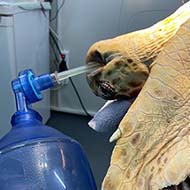
Pictured: Valentine under anaesthetic.
Veterinary professionals from Wildlife Vets International (WVI) performed a lifesaving operation on an endangered turtle at the ARCHELON Sea Turtle Rescue Centre in Greece.
Valentine, the endangered loggerhead, had arrived at the Archelon rescue centre weak and in poor condition. She has a thick fishing line hanging out of her cloaca, and an X-ray revealed that she had a large fishing hook embedded in her oesophagus.
Matthew Rendle RVN, veterinary surgeon Tania Monreal, and Archelon's lead biologist and rehab coordinator Eirini Kasimati, decided that anaesthetising Valentine to remove the hook was her only option.
After Valentine was given strong painkillers, along with a combination of anaesthetic drugs, Tania made an incision at the top of Valentine's thorax, and after locating the hook, was able to gently remove it with artery forceps.
The team were unable to remove the fishing line, however, since it had been cut from the hook, Valentine was able to pass it three days later.
Following her recovery, Valentine was released back into the sea, and now has the chance to breed successfully.
Executive director of WVI, Olivia Walter, commented: "We are delighted that Animal Friends was able to support the work of our Turtle Team and are so happy that Valentine was able to be released back into the sea so soon, where, as a breeding female, she should be able to do her bit to ensure the future of her amazing species.”
Westley Pearson chief executive officer at Animal Friends Insurance, which supports the Turtle Programme, added: “Wildlife Vets International is playing such an important role in successfully rehabilitating endangered turtles threatened by record levels of plastic pollution in the sea.
“The critical veterinary support, sharing of knowledge and the training they provide to endangered turtle rehabilitation centres, is ensuring more people on the conservation frontline are able to use veterinary science so that majestic turtles like Valentine can survive and thrive.”


 A nationwide roadshow offering free, personalised parasite risk assessments and flea and tick checks will be visiting popular dog events across the UK.



