
Your data on MRCVSonline
The nature of the services provided by Vision Media means that we might obtain certain information about you.
Please read our Data Protection and Privacy Policy for details.

In addition, (with your consent) some parts of our website may store a 'cookie' in your browser for the purposes of
functionality or performance monitoring.
Click here to manage your settings.
If you would like to forward this story on to a friend, simply fill in the form below and click send.

Your friend's email:
Your email:
Your name:
 
 
Send Cancel

Giant rabbits susceptible to unusual fracture
"It is important that vets and owners are aware of the apparent increased risk of fractures." - Professor Dylan Clements.

The underlying reason for this is unclear, researchers say. 

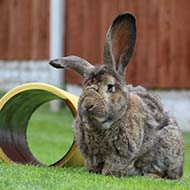
Researchers and veterinary surgeons at the University of Edinburgh have discovered that giant breed rabbits are at risk of an unusual, but recoverable, type of fracture.


This discovery was made when four male neutered continental giant rabbits aged between 10 and 30 months were presented at the Dick Vet with femoral condylar fractures, all of which developed without a traumatic injury being observed. 

The fracture occurs at the end of the thigh bone, where it forms the knee joint with the lower leg, and the underlying cause of this unusual fracture affecting this breed is unclear. 

The study, published in the Journal of Small Animal Practice (behind a paywall), details four cases presented to the practice, in which stabilisation was achieved with screw fixation in all four rabbits, with additional fixation in three of the cases. 

Of the four rabbits presented, three recovered normal limb function, whilst one developed a femoral fracture as a consequence of the surgical intervention, and was treated with an amputation. 

The results of the study suggest that giant rabbits' predisposition to the fracture could be weakness in the bones, or that the fractures are caused by stress.

Professor Dylan Clements, professor of small animal orthopaedics, commented: “This is a very uncommon fracture, yet we saw it only in a less common breed of rabbit. 

“It is important that vets and owners are aware of the apparent increased risk of fractures of this sort in Continental Giant breed rabbits.”

Become a member or log in to add this story to your CPD history

New RCVS Academy courses to remove barriers in vet care

News Story 1
 The RCVS Academy has launched two courses to its new client support series, as it seeks to improve accessibility in veterinary settings.

The courses will help professionals to support assistance dog partnerships and clients with hearing loss.

The Hearing loss and Assistance dogs courses saw RCVS project lead Catherine Hemingway collaborate with the British Deaf Association and Assistance Dogs UK. Vets will gain practical guidance on supporting clients with additional needs.

Each course takes an hour to complete, and can be accessed by RCVS registrants for free. 

Click here for more...
News Shorts
APHA launches free virtual work experience programme

The Animal and Plant Health Agency (APHA), in collaboration with Springpod, has launched a free virtual work experience programme, giving young people across the UK the chance to explore careers dedicated to protecting animal and plant health.

The on-demand programme offers a unique insight into career opportunities within APHA, showcasing how students can contribute to tackling some of the UK's most critical biosecurity and environmental challenges.

Designed for students aged 13 and over, the course includes more than 10 hours of engaging content featuring real-life industry insights, scenario-based challenges, and practical guidance on applying for jobs. To register for the course, visit the APHA website.

