
Your data on MRCVSonline
The nature of the services provided by Vision Media means that we might obtain certain information about you.
Please read our Data Protection and Privacy Policy for details.

In addition, (with your consent) some parts of our website may store a 'cookie' in your browser for the purposes of
functionality or performance monitoring.
Click here to manage your settings.
If you would like to forward this story on to a friend, simply fill in the form below and click send.

Your friend's email:
Your email:
Your name:
 
 
Send Cancel

Vet warns of 'screw tail' dangers
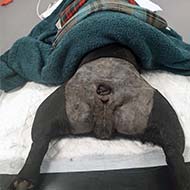
"Unfortunately, 'screw tail' is an issue that is common in these breeds." - Bart Hendrickx.
'We are seeing an increase in these congenital tail malformations.' 

A vet at West Midlands Referrals (WMR) has warned pet owners about the dangers of chronic pain and infection caused by screw tail – a condition which affects English and French bulldogs and pugs.

Screw tail, also known as 'ingrown tail' and 'corkscrew tail', is a genetic abnormality, where fused tail vertebrae form a spiral curvature, which can cause excessive skin folds, tail immobility, and anal obstruction. 

Bart Hendrickx, senior veterinary surgeon at West Midlands Veterinary Referrals in Staffordshire, spoke out about the problem after performing a tail amputation on a French bulldog. 

Bart said: “Screw tail is a developmental issue where the dog’s tail is formed into a corkscrew that twists the overlying skin into pockets and recesses. 

“This moist, warm area is then a perfect environment for growth of microbes, which then lead to chronic infection causing significant discomfort. 

“The only way to deal with this is to remove the warm damp recesses and that means the amputation of the cork-screw tail and with it the infected skin folds. 

“There is no other way to solve the problem but, fortunately, there are no adverse consequences of removing the tail, which in these breeds is stumpy and essentially immobile anyway. 

“Unfortunately, though, ‘screw tail’ is an issue that is common in these breeds and we are seeing an increase in these congenital tail malformations and deformities.” 

Bart spoke up about the condition after operating on Pippi, the French bulldog – who had a screw tail malformation with secondary pyoderma, and was referred to WMR for surgery. 

Pippi's operation lasted for 30 minutes, and she has since made a full recovery. 

Become a member or log in to add this story to your CPD history

Defra shares new Sanitary and Phytosanitary guidance

News Story 1
 Defra has published guidance for the vet sector ahead of a proposed UK-EU Sanitary and Phytosanitary agreement.


The agreement, which will change the movement and trade of animals and related products, could see reductions in checks, paperwork and certification. As well as describing regulatory developments, the advice highlights the importance of animal ID, registration and traceability in disease control and other compliance arrangements.

The guidance can be found here. More detail is expected as negotiations progress. 

Click here for more...
News Shorts
BSAVA publishes fifth Manual of Canine and Feline Neurology

The BSAVA has published the fifth edition of its BSAVA Manual of Canine and Feline Neurology.

The new edition has been reviewed and updated, including new developments in diagnostics, therapeutic approaches and clinical decision-making. It is structured to support clinicians through diagnosis, treatment and long-term management.

The guide features five new chapters covering acute myelopathies, chronic myelopathies, emergency protocols, neurotoxicology and neuro-oncology.

It also includes over 100 videos, including demonstrations of neurological examinations, clinical presentations and diagnostic procedures.

Nicola Lloyd, publishing manager, said: "Whether you're a general practitioner seeking practical guidance, or a specialist aiming to refine your expertise, this edition remains an indispensable reference for anyone involved in the care of neurologically compromised dogs and cats."
