


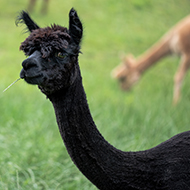
Chief vet states "disease control measures must be applied.”
A petition to save an alpaca from death after testing positive twice for bovine tuberculosis (bTB) has amassed more than 98,000 signatures.
Eight-year-old Geronimo, who lives in South Gloucestershire, tested positive for the disease four years ago after arriving in the UK from New Zealand.
Since then, owner Helen Macdonald, an RVN, is reported to have spent tens of thousands of pounds in legal fees trying to save him. She has also vowed to “stand in the way of any gunman who comes to destroy Geronimo” and has called into question the reliability of the tests.
But the UK’s Department for Environment, Food & Rural Affairs (Defra) maintains that the alpaca is required to be put down by law. A spokesperson for the Department said:
"The test used on Geronimo is highly specific, it is validated, it is reliable and the risk of a false positive is extremely low. A retest after two consecutive positive test results wouldn't invalidate the previous tests. So, there's no plans for any further tests.
"We recognise how distressing this clearly is for Ms Macdonald, as it is for farmers who have had to put cattle down - 27,000 had to be put down last year alone. We need disease control measures to be applied consistently if we are able to tackle it and obviously that's why we need to move ahead now.”
Macdonald lost a final High Court appeal on Thursday (5 August) to save Geronimo from being put down. Defra now has 30 days in which it can legally visit Ms Macdonald's farm to carry out the order.
Speaking out on the issue for the first time, environment secretary George Eustice wrote in the Mail on Sunday: “Farmers understand that infected animals are a risk to the remainder of their herd, so while the loss of individual animals is always a tragedy, the farming communities have worked with our Government vets in this arduous but necessary endeavour.
Chief veterinary officer Christine Middlemiss has also spoken out on the matter, adding: “While I sympathise with Ms Macdonald’s situation, we need to follow the scientific evidence and cull animals that have tested positive for TB, to minimise spread of this insidious disease, and ultimately to eradicate the biggest threat to animal health in this country.
“The tests used on Geronimo were developed for use on alpacas and are highly specific – the chances of a false positive are significantly less than one per cent, and we have tested him twice. Not just for the benefit of our farming industry but to avoid more TB cases in humans, our disease control measures must be applied.”


 Defra has published guidance for the vet sector ahead of a proposed UK-EU Sanitary and Phytosanitary agreement.



