
Your data on MRCVSonline
The nature of the services provided by Vision Media means that we might obtain certain information about you.
Please read our Data Protection and Privacy Policy for details.

In addition, (with your consent) some parts of our website may store a 'cookie' in your browser for the purposes of
functionality or performance monitoring.
Click here to manage your settings.
If you would like to forward this story on to a friend, simply fill in the form below and click send.

Your friend's email:
Your email:
Your name:
 
 
Send Cancel

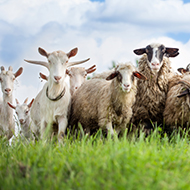
Goats adapt more quickly to changing environmental conditions than sheep
Goats and sheep are very similar animals, however they differ greatly in the way that they forage.

Study suggests that goats 'are more cognitively flexible than sheep'.

A new study by researchers at Martin Luther University Halle-Wittenberg (MLU) and the Leibniz Institute for Farm Animal Biology (FBN) investigated how sheep and goats 'problem-solve' to navigate around obstacles to reach food.

Dr Christian Nawroth from FBN explains: “It is important that animals are able to react swiftly to a changing environment because this allows them to find and exploit new food sources.”

An experiment was set up with 21 goats and 28 sheep at the Agroscope research centre in Switzerland, Queen Mary University London (QMUL) and the Buttercups Sanctuary for Goats in Kent.

The experiment saw one animal at a time led to one end of a small enclosure, with a researcher stood at the opposite end offering food and a fence with a gap in-between the two.

The researchers examined the animals' behaviour and recorded the time it took them to reach the food. After a few attempts, they changed the position of the gap in the fence and repeated the test.

In the first round, goats managed to walk around the obstacle quickly and more easily, although sheep were faster on average. Both types of animals needed a few attempts to adjust to the new position of the gap in the second round, but made fewer mistakes after this.

“Goats appear to adapt better and more accurately to new situations and move with less perseveration around the obstacle when the gap has changed.” Said co-author Dr Britta Osthaus from Canterbury Christ Church University.

“This suggests that they are more cognitively flexible than sheep.” The researcher added that the reason for these differences could be differing foraging strategies, as sheep are foragers while goats are 'browsers', preferring buds and fresh shoots.

Become a member or log in to add this story to your CPD history

Vets and vet nurses needed for nutrition study

News Story 1
 The University of Glasgow is seeking participants for a new study into vet professionals nutrition-related knowledge, competence and decision-making.


UK-based veterinary surgeons and registered veterinary nurses are being invited to take part in a project investigating nutrition-related patient care and client advice. Participants must have been qualified for between two and 10 years, and must be currently working in clinical practice with small animals.

To register to take part, those interested should complete a screening questionnaire. 

Click here for more...
News Shorts
APHA launches free virtual work experience programme

The Animal and Plant Health Agency (APHA), in collaboration with Springpod, has launched a free virtual work experience programme, giving young people across the UK the chance to explore careers dedicated to protecting animal and plant health.

The on-demand programme offers a unique insight into career opportunities within APHA, showcasing how students can contribute to tackling some of the UK's most critical biosecurity and environmental challenges.

Designed for students aged 13 and over, the course includes more than 10 hours of engaging content featuring real-life industry insights, scenario-based challenges, and practical guidance on applying for jobs. To register for the course, visit the APHA website.
