
Your data on MRCVSonline
The nature of the services provided by Vision Media means that we might obtain certain information about you.
Please read our Data Protection and Privacy Policy for details.

In addition, (with your consent) some parts of our website may store a 'cookie' in your browser for the purposes of
functionality or performance monitoring.
Click here to manage your settings.
If you would like to forward this story on to a friend, simply fill in the form below and click send.

Your friend's email:
Your email:
Your name:
 
 
Send Cancel

RSPCA urges dog owners to start preparing now for return to normality
"It's important that you aren't leaving your dog for too long during the day, or longer than they can cope with." - Sarah Tapsell, RSPCA.

“It's important to think ahead and begin to make gradual changes.”

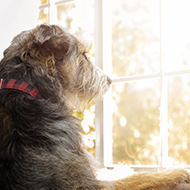
Following the Prime Minister's announcement of the roadmap out of lockdown, the RSPCA is encouraging pet owners to start taking steps to help their dogs adjust to normal life again.

Sarah Tapsell, one of the RSPCA’s regional clinical animal behaviourists, said: “You may have changed your routine with your dog if you are home more.

"Times for feeding, playing, walking and attention may all be slightly different. Your dog may be getting more or less of these things than before depending on the changes in your schedule.

“Changes in routine are something a dog can adapt to, but it is important to think ahead and begin to make gradual changes before you change your routine again when you go back to work. Otherwise, when things change again suddenly, it may come as a shock to your dog, even if they handled it well before COVID-19.

The charity recommends gradually changing a dog's routine to match as closely as possible with what its routine will be like after lockdown. This includes slowly adjusting location and length of walks and feeding times. As well as limiting periods of play and interaction to those times when the owner would normally be available, such as after dinner or in the evening.

“Remember that your dog is a social animal, it is normal for them to want and need to spend time with you” Ms Tapsell continued. “This means that it is important that you aren’t leaving your dog for too long during the day, or longer than they can cope with. Any dog left too long will struggle, with or without good advice to help them to cope.”

For more information please visit the RSPCA's COVID-19 hub.

Become a member or log in to add this story to your CPD history

Equine Disease Surveillance report released for Q4 2025

News Story 1
 The latest Equine Disease Surveillance report has been released, with details on equine disease from Q4 of 2025.

The report, produced by Equine Infectious Disease Surveillance, includes advice on rule changes for equine influenza vaccination.

Statistics and maps detail recent outbreaks of equine herpes virus, equine influenza, equine strangles and equine grass sickness. A series of laboratory reports provides data on virology, bacteriology, parasitology and toxicosis.

This issue also features a case study of orthoflavivus-associated neurological disease in a horse in the UK. 

Click here for more...
News Shorts
NSA webinar explores sheep tailing and castration

The National Sheep Association (NSA) is to host a free webinar on the castration and tail docking of lambs.

The webinar, 'Understanding the tailing and castration consultation: A guide for sheep farmers', will be hosted online on Monday, 2 March 2026 at 7.30pm.

It comes during a government consultation into the methods used for these procedures. Farmers are encouraged to engage before the consultation period closes on Monday, 9 March 2026.

The webinar offers clear and actionable guidance to support farmers to contribute meaningfully to the consultation and prepare for potential changes.

On the panel will be former SVS president Kate Hovers, farmer and vet Ann Van Eetvelt and SRUC professor in Animal Health and Veterinary Sciences Cathy Dwyer. Each panel member will utilise their own specialism and expertise to evaluate risks and outcomes to sheep farming.

Find out more about the webinar on the NSA website.

