Your data on MRCVSonline
The nature of the services provided by Vision Media means that we might obtain certain information about you.
Please read our Data Protection and Privacy Policy for details.

In addition, (with your consent) some parts of our website may store a 'cookie' in your browser for the purposes of
functionality or performance monitoring.
Click here to manage your settings.
If you would like to forward this story on to a friend, simply fill in the form below and click send.

Your friend's email:
Your email:
Your name:
 
 
Send Cancel

Dormouse rescued after getting stuck in garden bird feeder
The homeowner said that birds had continued to feed from the feeder while the dormouse sat inside.

Homeowner baffled upon finding sleeping creature in their garden

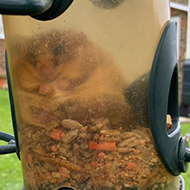
A dormouse that had been 'plumping up' for winter got itself into a tight spot when it managed to squeeze into a garden birdfeeder and needed help from the homeowner to get out.

The dormouse was spotted on Tuesday 17 November by the homeowner, who lives on the Isle of Wight. It's thought that the nocturnal animal got into the feeder overnight in search of food and then fell asleep when it became stuck inside.

The concerned Isle of Wight resident contacted the Hampshire Dormouse Group on Facebook, asking for urgent advice on how to get the creature out safely. The group sent them a link to register the animal on the National Dormouse Database and explained how and when to release it.

The dormouse was released successfully and quickly skittered away, apparently unscathed after its ordeal.

Catherine Hadler, a volunteer for the Hampshire Dormouse Group, was baffled when she saw the picture of the trapped dormouse.

“The dormouse had entered the bird feeder and eaten so much bird food that it was too chubby to get out,” she said. "Safe to say this fatty will survive hibernation just fine."

According to the group, dormouse populations in Britain have declined by 51 per cent since 2000. This is largely due to the destruction of hedgerows for housing developments and farmland.

The Hampshire Dormouse Group is urging the public to help dormice by reporting any sightings to the National Dormouse Database (NDD). This will help organisations to gain an understanding of where dormouse are living across the country, and will inform conservation efforts.

Image (c) Hampshire Dormouse Group.

Become a member or log in to add this story to your CPD history

Equine Disease Surveillance report released for Q4 2025

News Story 1
 The latest Equine Disease Surveillance report has been released, with details on equine disease from Q4 of 2025.

The report, produced by Equine Infectious Disease Surveillance, includes advice on rule changes for equine influenza vaccination.

Statistics and maps detail recent outbreaks of equine herpes virus, equine influenza, equine strangles and equine grass sickness. A series of laboratory reports provides data on virology, bacteriology, parasitology and toxicosis.

This issue also features a case study of orthoflavivus-associated neurological disease in a horse in the UK. 

Click here for more...
News Shorts
RCVS annual renewal fee for vets due

RCVS' annual renewal fee for veterinary surgeons is now due. Vets must pay their renewal fee before Wednesday, 1 April 2026.

This year's standard annual fee has increased to 431 from last year's 418. This is an approximately three per cent increase, as approved by RCVS Council and the Privy Council.

Tshidi Gardner, RCVS treasurer, said: "The small fee increase will be used to help deliver both our everyday activities and our new ambitious Strategic Plan, which includes aims such as achieving new legislation, reviewing the Codes of Professional Conduct and supporting guidance, and continuing to support the professions through activities such as the Mind Matters Initiative, RCVS Academy and career development."

A full breakdown of the new fees is on the RCVS website. Information about tax relief is available on the UK government website.