
Your data on MRCVSonline
The nature of the services provided by Vision Media means that we might obtain certain information about you.
Please read our Data Protection and Privacy Policy for details.

In addition, (with your consent) some parts of our website may store a 'cookie' in your browser for the purposes of
functionality or performance monitoring.
Click here to manage your settings.
If you would like to forward this story on to a friend, simply fill in the form below and click send.

Your friend's email:
Your email:
Your name:
 
 
Send Cancel

Researchers discover new primate species in Myanmar
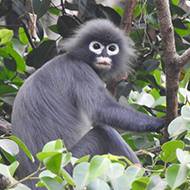
The Popa langur resides in central Myanmar.

Animal dubbed the Popa langur is threatened by habitat loss and hunting.

Fauna & Flora International has announced the discovery of a new primate species in Myanmar following the analysis of a 100-year-old specimen.

The new species, dubbed the Popa langur, is described in the journal Zoological Research and follows years of study by the German Primate Centre (DPZ), Leibniz Institute for Primate Research in Göttingen, and conservation NGO Fauna & Flora International (FFI). 

Found only in central Myanmar, Langurs are named after the sacred Mount Popa - an extinct volcano featuring an important wildlife sanctuary. The species is said to differ from known species in its fur colouration, tail length and skull measurements.

A DNA analysis, using a 100-year-old tissue sample from the London Natural History Museum, revealed that Langurs separated from known species around one million years ago. There are now said to be just 200 to 250 of the animals residing in four isolated populations in Myanmar. 

Researchers say that across their range, Langurs are threatened by habitat loss and hunting, and can therefore be considered as critically endangered. Christian Roos, a scientist in the primate genetics laboratory at DPZ said:

“The DNA analysis of a museum specimen collected for the London Natural History Museum more than 100 years ago has finally led to the description of this new species, confirmed also by samples collected from the field by FFI’s research team.”

Ngwe Lwin, an FFI primatologist in Myanmar, added: “Additional field surveys and protection measures are urgently required and will be conducted by FFI and others to save the langurs from extinction.”

Image (C) Aung Ko Lin/FFI.

Become a member or log in to add this story to your CPD history

Defra shares new Sanitary and Phytosanitary guidance

News Story 1
 Defra has published guidance for the vet sector ahead of a proposed UK-EU Sanitary and Phytosanitary agreement.


The agreement, which will change the movement and trade of animals and related products, could see reductions in checks, paperwork and certification. As well as describing regulatory developments, the advice highlights the importance of animal ID, registration and traceability in disease control and other compliance arrangements.

The guidance can be found here. More detail is expected as negotiations progress. 

Click here for more...
News Shorts
BSAVA publishes fifth Manual of Canine and Feline Neurology

The BSAVA has published the fifth edition of its BSAVA Manual of Canine and Feline Neurology.

The new edition has been reviewed and updated, including new developments in diagnostics, therapeutic approaches and clinical decision-making. It is structured to support clinicians through diagnosis, treatment and long-term management.

The guide features five new chapters covering acute myelopathies, chronic myelopathies, emergency protocols, neurotoxicology and neuro-oncology.

It also includes over 100 videos, including demonstrations of neurological examinations, clinical presentations and diagnostic procedures.

Nicola Lloyd, publishing manager, said: "Whether you're a general practitioner seeking practical guidance, or a specialist aiming to refine your expertise, this edition remains an indispensable reference for anyone involved in the care of neurologically compromised dogs and cats."
