


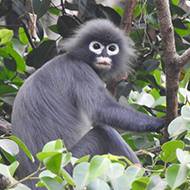
Animal dubbed the Popa langur is threatened by habitat loss and hunting.
Fauna & Flora International has announced the discovery of a new primate species in Myanmar following the analysis of a 100-year-old specimen.
The new species, dubbed the Popa langur, is described in the journal Zoological Research and follows years of study by the German Primate Centre (DPZ), Leibniz Institute for Primate Research in Göttingen, and conservation NGO Fauna & Flora International (FFI).
Found only in central Myanmar, Langurs are named after the sacred Mount Popa - an extinct volcano featuring an important wildlife sanctuary. The species is said to differ from known species in its fur colouration, tail length and skull measurements.
A DNA analysis, using a 100-year-old tissue sample from the London Natural History Museum, revealed that Langurs separated from known species around one million years ago. There are now said to be just 200 to 250 of the animals residing in four isolated populations in Myanmar.
Researchers say that across their range, Langurs are threatened by habitat loss and hunting, and can therefore be considered as critically endangered. Christian Roos, a scientist in the primate genetics laboratory at DPZ said:
“The DNA analysis of a museum specimen collected for the London Natural History Museum more than 100 years ago has finally led to the description of this new species, confirmed also by samples collected from the field by FFI’s research team.”
Ngwe Lwin, an FFI primatologist in Myanmar, added: “Additional field surveys and protection measures are urgently required and will be conducted by FFI and others to save the langurs from extinction.”
Image (C) Aung Ko Lin/FFI.


 Two independent vets have launched a podcast to help owners strengthen their bond with pets. Dr Maggie Roberts and Dr Vanessa Howie, who have worked in both veterinary practice and major charities, are keen to use their experience to enable people to give pets a better life.



