
Your data on MRCVSonline
The nature of the services provided by Vision Media means that we might obtain certain information about you.
Please read our Data Protection and Privacy Policy for details.

In addition, (with your consent) some parts of our website may store a 'cookie' in your browser for the purposes of
functionality or performance monitoring.
Click here to manage your settings.
If you would like to forward this story on to a friend, simply fill in the form below and click send.

Your friend's email:
Your email:
Your name:
 
 
Send Cancel

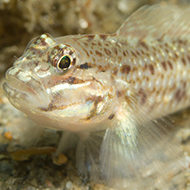
Goby fish fins may be as sensitive as human fingertips, study suggests
The team studied goby fish from Lake Michigan as they manouvered over different surfaces.

Researchers observe how goby fish use their fins to interact with different surfaces.

A new study by the University of Chicago has found that goby fish fins might be as sensitive to touch as human fingertips.

The findings, published in the Journal of Experimental Biology, suggest that human ability to detect differences between surfaces and shapes likely evolved in a distant common ancestor.

In the study, researchers set out to see if bottom-dwelling goby fish could feel different surfaces with their fins.

The team collected goby fish from Lake Michigan and filmed them in a tank as they manoeuvred over different surfaces, such as a piece of slate or plastic. They noted how the fish’s fins splayed out over each surface, similar to how a human might place their hand on a surface.

Researchers then set out to see if the fish could differentiate between fine variations, such as that of different grades of gravel. They designed a rotating wheel with ridges spaced along the edges and studied the nerve signals that the touch produced.

Study author Adam Hardy said that the nerve responses matched the pattern of the ridges, suggesting that gobies could be as sensitive to detecting coarse surface textures as the finger pads on primate.

“Primates are often held up as the gold standard in tactile sensitivity, so it was really exciting to see that fish fins exhibit a similar tactile response," he said.

He added that the gobies’ tactical sensitivity could have originated far back in evolution.

“This primate hand-like touch also suggests that the ability to detect surface differences via touch has been around a lot longer than we previously thought,” he said.

Become a member or log in to add this story to your CPD history

FIVP publishes CMA Compliance Checklist

News Story 1
 FIVP has published a CMA Compliance Checklist to support independent practices with the Market Investigation Order.

The document includes deadlines for small and large businesses, with tick boxes for each of the tasks. The organisation also invites practices to contact them for support with requirements.

Rita Dingwall, FIVP chair, said: FIVP appreciates that navigating the new CMA requirements can feel daunting. We hope this checklist will make things a little easier, helping independent practices work through what is required with confidence. 

Click here for more...
News Shorts
APHA launches free virtual work experience programme

The Animal and Plant Health Agency (APHA), in collaboration with Springpod, has launched a free virtual work experience programme, giving young people across the UK the chance to explore careers dedicated to protecting animal and plant health.

The on-demand programme offers a unique insight into career opportunities within APHA, showcasing how students can contribute to tackling some of the UK's most critical biosecurity and environmental challenges.

Designed for students aged 13 and over, the course includes more than 10 hours of engaging content featuring real-life industry insights, scenario-based challenges, and practical guidance on applying for jobs. To register for the course, visit the APHA website.

