


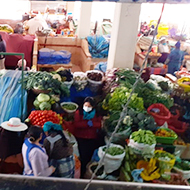
Project to identify ways of reducing transmission in traditional food markets.
The Royal Veterinary College (RVC) has received £749,735 of funding to contribute to the global effort on COVID-19 research.
Awarded by the National Institute for Health Research (NIHR) and UK Research and Innovation (UKRI), the money will support a collaborative project which seeks to reduce COVID-19 transmission in traditional food markets in Bolivia and Peru.
Javier Guitian, a professor of veterinary public health at the RVC, explains: “Bolivia and Peru have been severely hit by the COVID-19 pandemic. The more vulnerable sectors of the society have been affected, not only by the pandemic itself but also by control measures such as school closures, strict lockdowns and collapse of health care services, which disproportionately affected those with fewer resources who largely rely on the informal economy and lack a safety net.”
In the project, researchers will co-design bespoke plans to reduce transmission of the virus in Sacaba, Bolivia and Huancayo, Peru, and will also share their experience and online resources to help facilitate similar efforts in other countries. Contributing researchers comprise the RVC, London School of Hygiene and Tropical Medicine, Universidad Peruana Cayetano Heredia, Universidad Nacional Mayor de San Marcos and Universidad Mayor de San Simon.
Eloy Gonzales-Gustavson, an assistant professor at Universidad Nacional Mayor de San Marcos and researcher at Universidad Peruana Cayetano Heredia, said: “During the quarantine in Peru, markets were the focus of transmission and the government did not know how to establish response strategies, resulting in one of the highest rates of infection and mortality.
“With this project, we hope to develop new and innovative strategies that would help address another outbreak of COVID-19 as well as future epidemics, and to establish this with the help of the local market sellers and scientists from the UK, Peru and Bolivia.”
Image (C) Christine Leyns.


 Veterinary practices are being urged to help owners safely dispose of any unused and expired pet medicines - not just antibiotics - during November's Animal Medicines Amnesty.



