


Dogs process faces differently to humans, study suggests
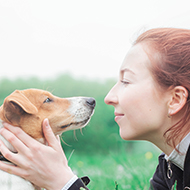
The study suggests that dogs do not possess brain regions that specifically respond to the front or the back of the head.
Researchers in Hungary have discovered striking similarities and differences in the way humans and dogs process faces.
Findings published in the Journal of Neuroscience suggest that dogs' brains are not engineered to respond to human faces - and there are no regions in the canine brain that can distinguish between the front or the back of the head.
Faces are so vital for human commination and other primates that they possess a dedicated neural network for processing. While dogs may have evolved to initiate eye contact with humans, they also rely on additional body language to communicate.
In the study, neuroscientists from Eötvös Loránd University used functional MRI to see if dogs' brains are wired for face processing like human brains. Researchers used the technology to compare the brain activity of 20 humans and 30 pet dogs, as they watched short films of other humans and dogs.
In terms of similarities, the study revealed that brain areas in both dogs and humans responded differently to the videos, depending on whether it was showing an individual from their own species.
Attila Andics, senior author of the study, said: "Earlier, our research group already showed a similar correspondence between dog and human brains for voice processing. We now see that species-sensitivity is an important organizing principle in the mammalian brain for processing social stimuli, in both the auditory and the visual modality."
Regarding differences, researchers found that unlike humans, dogs do not possess brain regions that specifically respond to the front or back of the head.
First author Nóra Bunford, explained: "A preference analysis of the brain response patterns confirmed that in dogs, conspecific-preference is primary over face-preference and in humans, face-preference is primary over conspecific-preference. This is an essential difference.
“It demonstrates that there can be substantial dissimilarities in cortical specialization for face perception across mammals. Actually, these findings also shed new light on previous dog fMRI studies claiming to have found 'face areas': we now think that the stronger activity to dog faces in those studies indicated dog-preferring rather than face-preferring brain areas."


 Veterinary practices are being urged to help owners safely dispose of any unused and expired pet medicines - not just antibiotics - during November's Animal Medicines Amnesty.



