


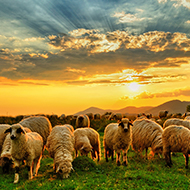
Genetic 'flip-flop' timer key to functions such as fertility, researchers conclude.
A new study led by the Universities of Edinburgh and Manchester has revealed insights into how how animals adapt between seasons.
Published in the journal Nature Communications, the study reveals how a biological switch helps animals make changes that are key to their survival, such as adjusting body temperature and growing a warm, winter coat.
The study of sheep shows how the brain changes in response to daylight hours to enable animals to adapt to the changing conditions. Researchers say that it could also help explain seasonal adaptions in other species, such as mammals, birds and reptiles.
“Fluctuations in hormones and behaviour are part of a delicate biological orchestra that is crucial to life,” explained Professor Simone Meddle, who co-led the research from the University of Edinburgh’s Roslin Institute. “Many animals depend on seasonal changes in their biology to survive and our findings are a crucial part of the puzzle to understand the underlying processes.”
Circadian rhythms – the 24 hour cycles that govern physical, mental and behavioural changes – alter during the course of a day and are influenced by genetics. Comparable rhythms also occur seasonally, but until this study it was not understood how genes play a role in the biological changes that fluctuate between summer and winter.
In the study, researchers studied the pituitary gland in sheep experiencing short or long lengths of day. They analysed brain tissue for gene activity across time, which enabled them to see how the biological processes respond to different day lengths.
The team found that one of two possible biological mechanisms is activated within the pituitary gland depending on whether the day is long or short.
When nights are long in summer, the brain generates hormones that cause a deluge of genetic activity leading to biological characteristics associated with summer. In winter, however, the switch is flipped and night time hormones are released for longer, triggering biological processes linked to this season.
The study concludes that, in the sheep brain, both processes involve a circadian gene known as BMAL2 – a gene that is found in many animals, but whose role in the seasonal clock was previously unknown.
“The genetic ‘flip-flop’ timer we have identified is key to functions such as fertility as sheep transition between winter and summer,” said Professor Andrew Loudon, who co-led the study from the University of Manchester. “We speculate that this genetic timer is likely to be fundamental to yearly changes in many species.”


 Companies marketing medicines for small pets exempt from authorisation must submit their annual return to the Veterinary Medicines Directorate (VMD) by 30 November 2026.



