
Your data on MRCVSonline
The nature of the services provided by Vision Media means that we might obtain certain information about you.
Please read our Data Protection and Privacy Policy for details.

In addition, (with your consent) some parts of our website may store a 'cookie' in your browser for the purposes of
functionality or performance monitoring.
Click here to manage your settings.
If you would like to forward this story on to a friend, simply fill in the form below and click send.

Your friend's email:
Your email:
Your name:
 
 
Send Cancel

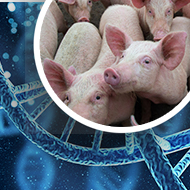
DNA discovery could pave the way to healthier pigs
The findings could help scientists accurately identify genetic similarites between pigs and humans.

Findings could help scientists develop pigs that are resistant to disease.

Scientists at the University of Edinburgh's Roslin Institute have decoded the entire genetic make-up of pigs in a development that could lead to healthier and more productive animals.

The findings, published in the journal GigaScience, could help scientists to develop pigs with desired characteristics, such as resistance to disease. They may also help researchers to accurately identify genetic similarities between pigs and humans.

Dr Amanda Warr from the Roslin Institute explains: “It’s a very exciting time to work in genomics. Genomes as complete as the ones we have produced would not have been possible without recent major advances in DNA sequencing technologies.

"The new reference genome provides scientists around the world with an accurate and complete framework on which to base their pig research, whereas before they were working with a very incomplete picture.”

The new reference genome was built using the very latest DNA-sequencing technology and provides information on the location of more than 21,000 pig genes.
Already, the improved quality of the reference has enabled researchers to identify a further 2,500 pig genes with an evolutionary link to a human gene, increasing the known number of such genes to 15,500.

Professor Alan Archibald, study lead and personal chair of mammalian molecular genetics at the Roslin Institute, said: “Pork is the most popular of all meats and, with a growing global population, we need to improve the sustainability of food production. The improved knowledge of pigs’ genetic make-up will help farmers breed healthier and more productive animals”.


Become a member or log in to add this story to your CPD history

Defra shares new Sanitary and Phytosanitary guidance

News Story 1
 Defra has published guidance for the vet sector ahead of a proposed UK-EU Sanitary and Phytosanitary agreement.


The agreement, which will change the movement and trade of animals and related products, could see reductions in checks, paperwork and certification. As well as describing regulatory developments, the advice highlights the importance of animal ID, registration and traceability in disease control and other compliance arrangements.

The guidance can be found here. More detail is expected as negotiations progress. 

Click here for more...
News Shorts
BSAVA publishes fifth Manual of Canine and Feline Neurology

The BSAVA has published the fifth edition of its BSAVA Manual of Canine and Feline Neurology.

The new edition has been reviewed and updated, including new developments in diagnostics, therapeutic approaches and clinical decision-making. It is structured to support clinicians through diagnosis, treatment and long-term management.

The guide features five new chapters covering acute myelopathies, chronic myelopathies, emergency protocols, neurotoxicology and neuro-oncology.

It also includes over 100 videos, including demonstrations of neurological examinations, clinical presentations and diagnostic procedures.

Nicola Lloyd, publishing manager, said: "Whether you're a general practitioner seeking practical guidance, or a specialist aiming to refine your expertise, this edition remains an indispensable reference for anyone involved in the care of neurologically compromised dogs and cats."