


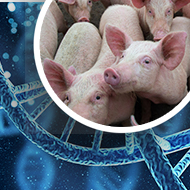
Findings could help scientists develop pigs that are resistant to disease.
Scientists at the University of Edinburgh's Roslin Institute have decoded the entire genetic make-up of pigs in a development that could lead to healthier and more productive animals.
The findings, published in the journal GigaScience, could help scientists to develop pigs with desired characteristics, such as resistance to disease. They may also help researchers to accurately identify genetic similarities between pigs and humans.
Dr Amanda Warr from the Roslin Institute explains: “It’s a very exciting time to work in genomics. Genomes as complete as the ones we have produced would not have been possible without recent major advances in DNA sequencing technologies.
"The new reference genome provides scientists around the world with an accurate and complete framework on which to base their pig research, whereas before they were working with a very incomplete picture.”
The new reference genome was built using the very latest DNA-sequencing technology and provides information on the location of more than 21,000 pig genes. Already, the improved quality of the reference has enabled researchers to identify a further 2,500 pig genes with an evolutionary link to a human gene, increasing the known number of such genes to 15,500.
Professor Alan Archibald, study lead and personal chair of mammalian molecular genetics at the Roslin Institute, said: “Pork is the most popular of all meats and, with a growing global population, we need to improve the sustainability of food production. The improved knowledge of pigs’ genetic make-up will help farmers breed healthier and more productive animals”.


 The BSAVA has opened submissions for the BSAVA Clinical Research Abstracts 2026.



