Your data on MRCVSonline
The nature of the services provided by Vision Media means that we might obtain certain information about you.
Please read our Data Protection and Privacy Policy for details.

In addition, (with your consent) some parts of our website may store a 'cookie' in your browser for the purposes of
functionality or performance monitoring.
Click here to manage your settings.
If you would like to forward this story on to a friend, simply fill in the form below and click send.

Your friend's email:
Your email:
Your name:
 
 
Send Cancel

Dog Assistance in Disability achieves re-accreditation
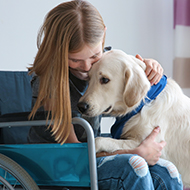
Dog A.I.D provides assistance dog training to people over 15 years old with physical disabilities.
Organisation will remain a member of Assistance Dogs International for a further five years. 

Assistance dog charity, Dog Assistance in Disability (Dog A.I.D) has achieved re-accreditation by Assistance Dogs International (ADI) for maintaining high standards of excellence in all areas of assistance dog acquisition, training and partnership.

A review conducted by a trained ADI assessor over two to four days found that the charity, which relies solely on voluntary income, met ADI's Standards of Practice. It means that Dog A.I.D will remain a member programme of the ADI - the leading authority in the dog assistance industry - for a further five years.

Dog A.I.D. chair Sandra Fraser comments: “We are delighted to receive re-accreditation for a further five years from ADI. We have been evaluated on program management, administration, facilities and community activities with gold seal achievement. Full credit goes to our staff, volunteers, clients and dogs for maintaining the highest of standards and dedication to make this possible”.

Based in Shropshire, Dog A.I.D provides assistance dog training to people over 15 years old with physical disabilities up to Assistance Dog standard where suitable. Where Dog A.I.D. differs from most assistance dog charities, is that the dogs they work with belong to the clients.

The organisation operates throughout the UK and currently has 117 fully qualified assistance dogs, with a further 121 in training. Once trained, the new assistance dogs provide vital, life-changing support to their owners, from emptying the washing machine and finding the telephone, to turning on the lights.

ADI is a worldwide coalition of non-profit organisations that raise, train and place assistance dogs. There are currently 133 ADI accredited service dog programmes throughout the world. 

Become a member or log in to add this story to your CPD history

Equine Disease Surveillance report released for Q4 2025

News Story 1
 The latest Equine Disease Surveillance report has been released, with details on equine disease from Q4 of 2025.

The report, produced by Equine Infectious Disease Surveillance, includes advice on rule changes for equine influenza vaccination.

Statistics and maps detail recent outbreaks of equine herpes virus, equine influenza, equine strangles and equine grass sickness. A series of laboratory reports provides data on virology, bacteriology, parasitology and toxicosis.

This issue also features a case study of orthoflavivus-associated neurological disease in a horse in the UK. 

Click here for more...
News Shorts
NSA webinar explores sheep tailing and castration

The National Sheep Association (NSA) is to host a free webinar on the castration and tail docking of lambs.

The webinar, 'Understanding the tailing and castration consultation: A guide for sheep farmers', will be hosted online on Monday, 2 March 2026 at 7.30pm.

It comes during a government consultation into the methods used for these procedures. Farmers are encouraged to engage before the consultation period closes on Monday, 9 March 2026.

The webinar offers clear and actionable guidance to support farmers to contribute meaningfully to the consultation and prepare for potential changes.

On the panel will be former SVS president Kate Hovers, farmer and vet Ann Van Eetvelt and SRUC professor in Animal Health and Veterinary Sciences Cathy Dwyer. Each panel member will utilise their own specialism and expertise to evaluate risks and outcomes to sheep farming.

Find out more about the webinar on the NSA website.