


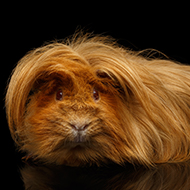
Researchers use ancient DNA from archaeological guinea pig remains.
A new study has shed light guinea pig domestication and how and why these popular pets became distributed around the world.
Writing in the journal Scientific Reports, researchers describe how they used ancient DNA from archaeological guinea pig remains to reveal their transmission from an ancient food source to much-loved pets.
It is commonly accepted that guinea pigs became domesticated in the Andes region of South America around 10,000 years ago. Guinea pigs were viewed as a vital food source and widely used in religious ceremonies.
But sometime around AD 500, guinea pigs were introduced to the islands of the Caribbean through at least one of several established networks. In the study, researchers set out to pinpoint where these guinea pigs originated.
Scientists expected the guinea pigs to have travelled via Colombia because it is one of the closest locations to the Caribbean. But, after extracting DNA from several archaeological sites in the Caribbean, Peru, Colombia, Bolivia, Europe and North America, they found it was more likely that the guinea pigs came from Peru.
Following an analysis of guinea pig remains found in the Colombian Highlands, researchers were also surprised to discover the guinea pigs were from a different species, suggesting that guinea pig domestication likely took place independently in both Peru and Colombia.
Professor Matisoo-Smith from the University of Otago, New Zealand, explains: “They [guinea pigs] were and still are important food item in many parts of South America and cultures that derived from South America – people took them to live to introduce to new islands where they were not native or they traded them for other goods.
“The guinea pig was brought to Europe in the late 1500s or early 1600s by the Spanish and to North America in the early 1800s as part of the exotic pet trade. In the 18th-century guinea pigs began to be used by medical researchers as laboratory animals because they have many biological similarities to humans, thus the origin of the phrase ‘being a guinea pig’ in research.
“All guinea pigs today - pets, those that are sold for meat in South America and Puerto Rico, and those used in medical research - are derived from the Peruvian domesticated guinea pigs.”
Researchers say their study shows that the history of guinea pigs is more complex than previously thought, and has implications for other studies regarding mammal domestication and distribution.
Professor Matisoo-Smith added: “Identifying the origins of the guinea pig remains from the Caribbean helps us to understand how the human trade networks in the region moved in the past 1000 years or so.
“Through this analysis of ancient guinea pig DNA, we better understand the history of human social interactions over thousands of years and across three continents. It also provides a critical historical perspective of the genetic diversity in guinea pigs and the relationship humans have had with this important domestic animals.”

 The latest



