


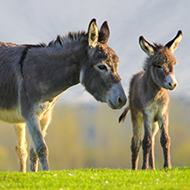
Rare disease discovered in 20 donkeys from the Donkey Sanctuary.
A chronic and debilitating equine disease has been identified in donkeys in the UK for the first time.
Writing in the journal Parasites and Vectors, researchers report the discovery of equine besnoitiosis in 20 donkeys from the Donkey Sanctuary during the period 2013-2019.
Equine besnoitiosis a rare disease that occurs in horses, donkeys, mules and zebras. Donkeys with the condition develop multiple parasitic cysts on the skin, over the nostrils, ears and face.
A unique feature of besnoitiosis is the development of tiny cysts on the surface of the eye. Some infected animals remain otherwise healthy, while others become thin and debilitated. Until recently, besnoitiosis was a rare condition in most countries, including in the US, Spain, Belgium, and Italy.
Equine besnoitiosis was first detected in the UK in 2013 when a donkey at the Donkey Sanctuary was presented with skin lumps presumed to be sarcoid tumours. Analysis of the affected skin tissue revealed the presence of cysts similar to those caused by the parasite Besnoitia bennetti, together with the finding of tissue changes associated with a sarcoid.
The discovery triggered a collaboration between clinicians at the Donkey Sanctuary and a veterinary parasitologist from the University of Nottingham. Since then more than 20 clinical cases have been identified and studied.
“Given the relative proximity to other European countries, where clinical besnoitiosis is apparent, our findings will inform British vets of the potential for this emerging disease so that they can better recognise the pattern of clinical signs during clinical examination, said Dr Rebekah Sullivan, co-author of the report and a vet at the Donkey Sanctuary.
Lead author Dr Hany Elsheikha of the University of Nottingham, said: “It is absolutely essential – particularly now – that vets in the UK learn more about besnoitiosis, so they can identify and protect donkeys potentially at risk.
“Knowledge obtained in this study should improve our response to this emerging parasitic disease in donkeys in the UK, especially with the few treatment options and the unknown routes of transmission.”


 Two independent vets have launched a podcast to help owners strengthen their bond with pets. Dr Maggie Roberts and Dr Vanessa Howie, who have worked in both veterinary practice and major charities, are keen to use their experience to enable people to give pets a better life.



