
Your data on MRCVSonline
The nature of the services provided by Vision Media means that we might obtain certain information about you.
Please read our Data Protection and Privacy Policy for details.

In addition, (with your consent) some parts of our website may store a 'cookie' in your browser for the purposes of
functionality or performance monitoring.
Click here to manage your settings.
If you would like to forward this story on to a friend, simply fill in the form below and click send.

Your friend's email:
Your email:
Your name:
 
 
Send Cancel

How to reduce face-to-face contact in veterinary practices
Alternative methods of communication can be used to carry out consultations and triage.

Social distancing for veterinary teams

Current government advice states that veterinary practices must reduce face to face contact immediately, in order to reduce transmission of COVID-19. This article covers several methods of introducing social distancing measures in practice, whilst continuing to provide veterinary care.

Alternative communication methods

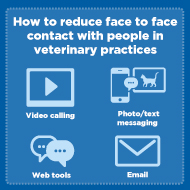
Use of technology, such as video or telephone calls, can be used to carry out certain consultations remotely. This also offers an alternative mode of working from home for veterinary surgeons.

Additionally, web tools – such as online chat support – emails and text messages can be used to maintain effective communication. Clients can be asked to send photos of their pets using these platforms, to aid in examinations and triage.

Limiting footfall in practice

If a client needs to visit the practice, social distancing can be maintained by requesting that only one person accompanies an animal per appointment, as well as by asking clients to wait in their cars, allowing staff to bring animals into the building for examination.

Clients can also be asked to wait in the carpark to collect prescriptions. Or these could be posted to the client's home.

If you have any suggestions on how to further reduce face to face contact in veterinary practices, please email editor@mrcvs.co.uk

Become a member or log in to add this story to your CPD history

New RCVS Academy courses to remove barriers in vet care

News Story 1
 The RCVS Academy has launched two courses to its new client support series, as it seeks to improve accessibility in veterinary settings.

The courses will help professionals to support assistance dog partnerships and clients with hearing loss.

The Hearing loss and Assistance dogs courses saw RCVS project lead Catherine Hemingway collaborate with the British Deaf Association and Assistance Dogs UK. Vets will gain practical guidance on supporting clients with additional needs.

Each course takes an hour to complete, and can be accessed by RCVS registrants for free. 

Click here for more...
News Shorts
APHA launches free virtual work experience programme

The Animal and Plant Health Agency (APHA), in collaboration with Springpod, has launched a free virtual work experience programme, giving young people across the UK the chance to explore careers dedicated to protecting animal and plant health.

The on-demand programme offers a unique insight into career opportunities within APHA, showcasing how students can contribute to tackling some of the UK's most critical biosecurity and environmental challenges.

Designed for students aged 13 and over, the course includes more than 10 hours of engaging content featuring real-life industry insights, scenario-based challenges, and practical guidance on applying for jobs. To register for the course, visit the APHA website.

