


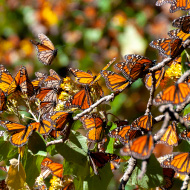
Warmer, wetter summers conducive to the successful development of caterpillars
Following years of decline, butterfly populations in the United Kingdom appear to be on the rise, according to new research.
Figures from the UK Butterfly Monitoring Scheme (UKBMS) show that last summer was the best since 1997, with more than half of butterfly species showing higher population levels.
Conservationists say that butterflies most likely benefited from an unusually warm and wet summer, which is conducive to the successful development of caterpillars.
Red admiral populations shot up by a staggering 195 per cent, while painted ladies rose by an enormous 1,993 per cent.
“The results from the 2019 season are really encouraging and provide evidence that the overall rate of decline of butterflies is slowing and for some species being reversed,” explained Professor Tom Brereton, associate director of monitoring and research at Butterfly Conservation.
“Reasons for this include positive conservation through agri-environment schemes, increased woodland cover, climate warming, increases in grazing levels by wild animals and a slowing in the rate of agricultural intensification.”
The species that benefited most from the conditions were the marbled white (up 66 per cent), the dark green fritillary (up 51 per cent), and the meadow brown (up 38 per cent). The rare Lulworth skipper, which is restricted to the Dorset coast, saw a whopping increase of 138 per cent.
But it isn't all good news. Figures also show that the common blue dropped in annual abundance by 54 per cent, the adonis blue by 40 per cent, the green-veined white by 43 per cent and the large white by 40 per cent, with all four species having below-average years.
Conservationists stress that this ongoing decline raises fears for the long-term future of butterflies, whose populations have fallen by 91 per cent in recent years.
“The UKBMS provides an excellent evidence base to help us understand how butterflies are faring,” commented Anna Robinson, monitoring ecologist at the Joint Nature Conservation Committee.
“This evidence is important to help inform environmental policy to take better account of biodiversity. We are really grateful for the input of the thousands of volunteers who have contributed from 1976 until today, and without whom the scheme would not be possible.”
The UK Butterfly Monitoring Scheme is led by Butterfly Conservation, the UK Centre for Ecology & Hydrology, British Trust for Ornithology (BTO) and Joint Nature Conservation Committee.


 Defra has published guidance for the vet sector ahead of a proposed UK-EU Sanitary and Phytosanitary agreement.



