
Your data on MRCVSonline
The nature of the services provided by Vision Media means that we might obtain certain information about you.
Please read our Data Protection and Privacy Policy for details.

In addition, (with your consent) some parts of our website may store a 'cookie' in your browser for the purposes of
functionality or performance monitoring.
Click here to manage your settings.
If you would like to forward this story on to a friend, simply fill in the form below and click send.

Your friend's email:
Your email:
Your name:
 
 
Send Cancel

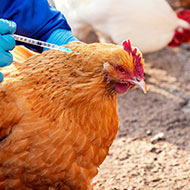
Leaky vaccines help reduce transmission of Marek’s disease
Leaky vaccines are currently the most commonly used method of controlling Marek's disease.

Study finds imperfect vaccines control severity of viral disease

A new study conducted on chickens infected with Marek’s disease has revealed that vaccines that do not prevent onward transmission or infection are more effective in controlling the severity of the disease than previously thought.

Researchers from the University of Edinburgh’s Roslin Institute and the US Department of Agriculture’s Avian Disease and Oncology laboratory (ADOL), conducted the study to analyse how leaky vaccines impact overall populations.

One group of chickens received a leaky vaccine – this contained a related live virus originating from turkeys, which triggers an immune response, but no symptoms. While a second control group was given a sham vaccine, which contained no biological material. Both groups were then infected with Marek’s disease virus and placed with different sets of unvaccinated chickens for 48 hours.

More than 97 per cent of the birds became infected. However, the unvaccinated chickens that had contact with those who had received the leaky vaccine were less likely to develop full-blown Marek’s disease and there were also fewer deaths. This was found to be a result of vaccinated birds transmitting fewer copies of Marek’s disease virus.

Lead author Dr Richard Bailey, who is also a research fellow at the Roslin Institute, said: “In our study, we found that leaky vaccines can provide benefit in terms of reducing the presence and severity of symptoms, and mortality, caused by Marek’s disease even for unvaccinated chickens. We need further research to understand how this effect changes as the virus mutates and in other strains of chickens.” 

Become a member or log in to add this story to your CPD history

Building Great Workplaces webinars return

News Story 1
 BVA has announced a new series of its Building Great Workplaces lunchtime webinars.

Launching from 16 July, the sessions will explore patient safety, motivation, client communication and more.

Its first webinar, exploring neurodiversity in the workplace, will take place at 1pm on Thursday, 16 July. It will feature guest speakers from The Vet Project, a group which supports neurodiversity in veterinary environments.

The following three webinars take place in September, October and November.

Booking is open on the BVA website 

Click here for more...
News Shorts
New form for online veterinary medicines retailers

The Veterinary Medicines Directorate (VMD) has produced a new online form for retailers wishing to sell veterinary medicines on the internet.

The form replace the previous Word version and is part of the VMD's ongoing commitment to digitise its processes. Anyone retailing prescription medicines online, including POM-V, POM-VPS and NFA-VPS categories, is lawfully required to register with the VMD before trading.

The change only applies to new applicants. Retailers already listed on the VMD's Register of Online Retailers or registered under the Accredited Internet Retailer Scheme (AIRS) do not need to do anything.

