


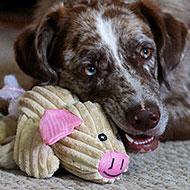
Adding lavender or rabbit scent to toys could improve the welfare of dogs in kennels
A new study has found that the welfare of kennelled dogs could be improved if they’re able to play with scented toys.
Being held in a rehoming centre can be extremely stressful for dogs, and one way to improve this can be to provide toys. However, studies of kennel dogs have found that few animals actually play with them.
In this study, researchers employed 44 kennelled dogs over the age of one that were under the care of a Dogs Trust rehoming centre. Lavender or rabbit scents were applied to the toys, and researchers compared the dogs’ behaviour with these toys with ones that were unscented.
Researchers found that the dogs were more likely to play with the scented toys, but they also noticed that the dogs displayed more positive behaviours. For example, the dogs that played with the scented toys explored their kennel and the objects within it, while periods of rest and sleep were more likely to occur.
The team didn’t measure adoption success, but they did find that dogs that played with the scented toys were quieter and more playful - two traits that people often look for when they’re adopting a dog.
Furthermore, dogs that played with the scented toys weren’t necessarily the ones that showed an increase in other behaviours, suggesting that scent may be beneficial in itself, not just because it encourages the use of toys.
Study author Ben Brilot from Hartpury University said that such behaviours are associated with higher welfare and could potentially increase the chances of adoption from a rehoming centre:
“Our initial results look very promising, suggesting that adding scent to toys in rehoming kennels might, at least in the short-term, improve welfare outcomes,” he said. “The use of novel scents may, therefore, promote better welfare in kennels, but differing scents and longer-term observations, including rehoming success, need to be looked at.”
Dogs Trust’s research manager Naomi Harvey, added: “We are always looking for ways to improve the day-to-day experience for the thousands of dogs we care for across our 21 rehoming centres in the UK and Ireland.
“Scent is an incredibly important sense for dogs and while sniffing is a natural behaviour for them, it’s often overlooked as a form of enrichment. These results show that adding scent to toys could be a practical way of improving welfare for our dogs and we are pleased to support this research.”


 A nationwide roadshow offering free, personalised parasite risk assessments and flea and tick checks will be visiting popular dog events across the UK.



