


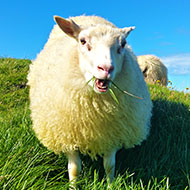
Researchers use GPS trackers to analyse foraging habits
A recent study from the University of Bristol has revealed that when foraging, less healthy sheep will avoid high-quality vegetation due to a higher risk of infection from ticks.
In this study, researchers from Bristol’s School of Biological Sciences and Veterinary School fitted GPS trackers to 23 ewes in the uplands of Dartmoor. The trackers were set to record the ewes’ location every two minutes over a period of eight days.
These 114,093 location recordings were then integrated with satellite data of vegetation quality, field sampling data showing tick prevalence, and parasite load and health measures for each sheep.
Analysis of this data showed that sheep assessed as more anaemic avoided dense, high-quality vegetation where ticks are typically found. By reducing encounter rates with ticks, these sheep also avoided a higher risk of infection.
In contrast, healthier sheep appeared undeterred by the potential risk of infection from ticks. Favouring areas providing greater high-quality vegetation and foraging intake.
Lead author Caroline Liddell, a Natural Environment Research Council (NERC) PhD student from Bristol’s School of Biological Sciences, said: “Discovering that the trade-off between maximising forage intake and minimising parasite encounter depends on the health status of individual sheep emphasises the need to study livestock as individuals, even in group-living animals such as sheep. GPS tracking technology provides a feasible and increasingly affordable means of obtaining such individual-level data.
“Our study, which used extensively grazed sheep as a model system, opens new possibilities to study free-living grazing systems, and illustrates the benefits of using GPS technology to advance our understanding in this area.
“Future studies could use controlled interventions, such as anti-parasitic treatment, to separate cause and effect and develop understanding of the processes generating the observed associations.”


 Veterinary practices are being urged to help owners safely dispose of any unused and expired pet medicines - not just antibiotics - during November's Animal Medicines Amnesty.



