
Your data on MRCVSonline
The nature of the services provided by Vision Media means that we might obtain certain information about you.
Please read our Data Protection and Privacy Policy for details.

In addition, (with your consent) some parts of our website may store a 'cookie' in your browser for the purposes of
functionality or performance monitoring.
Click here to manage your settings.
If you would like to forward this story on to a friend, simply fill in the form below and click send.

Your friend's email:
Your email:
Your name:
 
 
Send Cancel

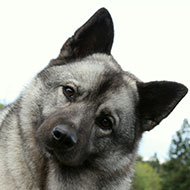
New DNA testing schemes for the Norwegian elkhound
The Kennel Club has approved two new official DNA testing schemes for primary open angle glaucoma and chondrodysplasia in the Norwegian elkhound.

Schemes to combat primary open glaucoma and chondrodysplasia

Two new DNA testing schemes to combat inherited disease in the Norwegian elkhound have been approved by the Kennel Club.

The DNA testing schemes, announced following consultation with the breed clubs, are for primary open glaucoma (POAG) and chondrodysplasia (CDSL).

POAG is caused by inadequate draining of fluid from the eye and can lead to irreversible blindness. Until now there has been no means of clinically screening for the conditions, and clinical signs tend to first appear in middle-aged dogs, often after breeding age.

Chondrodysplasia is a condition that affects the development and growth of the skeleton, manifesting as a shortening of the limbs or disproportionate dwarfism. The severity of the condition varies among the species.

“The Kennel Club works alongside breed clubs and breed health coordinators in a collaborative effort to improve the health of pedigree dogs and is happy to accommodate a club's request to add a new DNA test to its lists,” the Kennel Club said in a statement. 


“A formal request from the breed's health coordinator or a majority request from the breed clubs is normally required to do this. Test results will be added to the dog’s registration details which will trigger the publication of the result in the next available Breed Records Supplement. 


“The result will appear on any new registration certificate issued for the dog and on the registration certificates of any future progeny of the dog, and also on the Health Test Results Finder on the Kennel Club website.”


It is mandatory for the dog’s microchip (or tattoo) number to be recorded along wither the dog’s registered name or registered number on any DNA certificate. Test results that do not carry these features will not be included on the Kennel Club database.

To find out which laboratories the Kennel Club is able to record results from, and which labs will send results direct to the Kennel Club, to the worldwide DNA testing list at www.thekennelclub.org.uk/worldwide-dna-tests.

Image (C) Diane Pearce Collection/The Kennel Club.

Become a member or log in to add this story to your CPD history

New RCVS Academy courses to remove barriers in vet care

News Story 1
 The RCVS Academy has launched two courses to its new client support series, as it seeks to improve accessibility in veterinary settings.

The courses will help professionals to support assistance dog partnerships and clients with hearing loss.

The Hearing loss and Assistance dogs courses saw RCVS project lead Catherine Hemingway collaborate with the British Deaf Association and Assistance Dogs UK. Vets will gain practical guidance on supporting clients with additional needs.

Each course takes an hour to complete, and can be accessed by RCVS registrants for free. 

Click here for more...
News Shorts
APHA launches free virtual work experience programme

The Animal and Plant Health Agency (APHA), in collaboration with Springpod, has launched a free virtual work experience programme, giving young people across the UK the chance to explore careers dedicated to protecting animal and plant health.

The on-demand programme offers a unique insight into career opportunities within APHA, showcasing how students can contribute to tackling some of the UK's most critical biosecurity and environmental challenges.

Designed for students aged 13 and over, the course includes more than 10 hours of engaging content featuring real-life industry insights, scenario-based challenges, and practical guidance on applying for jobs. To register for the course, visit the APHA website.

