
Your data on MRCVSonline
The nature of the services provided by Vision Media means that we might obtain certain information about you.
Please read our Data Protection and Privacy Policy for details.

In addition, (with your consent) some parts of our website may store a 'cookie' in your browser for the purposes of
functionality or performance monitoring.
Click here to manage your settings.
If you would like to forward this story on to a friend, simply fill in the form below and click send.

Your friend's email:
Your email:
Your name:
 
 
Send Cancel

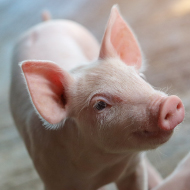
Piglet study shows prebiotics and probiotics work differently in baby girls and boys
"The consequence of this study is that we need to rethink how we design, and analyse the data from, nutritional trials in youngsters." - Dr Marie Lewis.

Findings could improve treatment of immune disorders

Teams from the Universities of Bristol and Reading have discovered that baby boy’s and girl’s immune systems respond differently to prebiotics and probiotics, contradicting previous evidence that the differences in immunity begin during puberty.

The research, which was conducted using 28-day-old piglets, revealed that, depending on their sex, they produced vastly varying levels of immune cells, antibodies and other immune-associated molecules.

It was also found that the prebiotic inulin significantly increases the number of regulatory T-cells – the cells responsible for controlling immune responses – in male guts, but this was not the case in female guts.

Principal investigator Dr Marie Lewis, lecturer in gut immunology and microbiology at the University of Reading said: “Currently, studies looking at the effectiveness of dietary supplements on the immune system assume that the same thing happens in boys and girls. But we show this is not the case and that sex may be influencing data on the effectiveness of probiotics and prebiotics in infanthood."

Dr Lewis also speculated that these findings may lead to differences in designing treatments for immune disorders for infant girls and boys.

“In the future, we could find that specific probiotics or prebiotics are more beneficial for girls, whilst others could generate better health outcomes for boys.

“Given the underlying differences in immune development we identified between boys and girls, taking sex into account could provide a simple means to improve the effectiveness of pharmaceutics and other therapies which act on the immune system."


Become a member or log in to add this story to your CPD history

Equine Disease Surveillance report released for Q4 2025

News Story 1
 The latest Equine Disease Surveillance report has been released, with details on equine disease from Q4 of 2025.

The report, produced by Equine Infectious Disease Surveillance, includes advice on rule changes for equine influenza vaccination.

Statistics and maps detail recent outbreaks of equine herpes virus, equine influenza, equine strangles and equine grass sickness. A series of laboratory reports provides data on virology, bacteriology, parasitology and toxicosis.

This issue also features a case study of orthoflavivus-associated neurological disease in a horse in the UK. 

Click here for more...
News Shorts
Applications open for BEVA Back in the Saddle

The British Equine Veterinary Association (BEVA) has opened applications for its 'Back in the Saddle' coaching programme.

The online scheme offers structured group coaching for members wanting to reflect on their career path and regain clarity. Members may be returning to work after leave, uncertain about next steps or reassessing direction.

Attendees will benefit from impartial guidance and practical tools to support their professional development. Members are encouraged to take a 'proactive, future-focused approach' to their careers.

The sessions, taking place on Wednesdays from 7.30pm-9pm, are open to BEVA members with more than five years' experience. The first session takes place on Wednesday, 3 June 2026.

Applications will close on Wednesday, 27 May 2026.

