


Advanced therapy offers new cancer treatment options
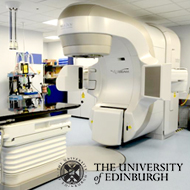
The University of Edinburgh’s Royal (Dick) School of Veterinary Studies has announced the introduction of a new linear accelerator, placing it at the forefront of veterinary cancer treatment in Europe.
The new accelerator is designed to provide more targeted treatment, meaning that higher doses of radiation can be given less frequently. It also means that patients can have a shorter stay in hospital and receive fewer anaesthetics.
Offering the same cutting edge treatment options you will find in any human hospital, the accelerator is equipped to deliver the most advanced forms of radiation therapy. This includes static gantry intensity-modulated radiation therapy (IMRT), dynamic gantry IMRT/RarpidArc, electron therapy and conventional 3D radiation therapy.
It will be operated by a team including American and European boarded veterinary radiation oncologist Dr Magdalena Parys, European board certified oncologist Juan Carlos Serra, and therapeutic radiographer Emma McCormick.
The University said in a press release: “IMRT is an advanced treatment technique, which allows the delivery of a precise dose of treatment to almost any tumour shape. In particular cases, this technique reduces the dose to normal structures, which decreases side effects in normal tissues which are close to the tumour.
“Secondly, can IMRT allow an increased total dose of radiation to be delivered to the tumour. A common example is the use of IMRT to spare the eyes, brain, skin and oral cavity when treating nasal tumours. R(D)SVS is the only place in the UK to offer IMRT.”
The accelerator is also equipped with cone-beam CT imaging facilities, which enables the radiation oncologist to position the animal with greater accuracy so that treatment is safer and more effective. It is the only veterinary linear accelerator UK with this capability.
The University added: "The new radiation unit will also soon be able to treat patients with stereotactic radiotherapy. This is a type of protocol that usually consists of one, two or three high-dose radiotherapy fractions, delivered with pin-point accuracy and in a short period of time.
“By giving much more targeted treatment you can give high doses less frequently as you are mainly hitting the tumour cells, not the adjacent normal tissues. It also means a shorter stay in the hospital and less anaesthetics. This type of radiotherapy treatment modality has been successfully implemented in other places in the world for many tumour types, such as nasal and brain tumours.”
Image (C) University of Edinburgh.


 Defra has published guidance for the vet sector ahead of a proposed UK-EU Sanitary and Phytosanitary agreement.



