Your data on MRCVSonline
The nature of the services provided by Vision Media means that we might obtain certain information about you.
Please read our Data Protection and Privacy Policy for details.

In addition, (with your consent) some parts of our website may store a 'cookie' in your browser for the purposes of
functionality or performance monitoring.
Click here to manage your settings.
If you would like to forward this story on to a friend, simply fill in the form below and click send.

Your friend's email:
Your email:
Your name:
 
 
Send Cancel

River Thames high in antibiotic-resistant bacteria
Ninety per cent of antibiotics taken by people enter the sewage system after passing through the body.

Researchers call for a significant cut in antibiotic prescriptions

Scientists studying the effect of antibiotic prescriptions on the environment say there would need to be an 80 per cent fall in antibiotics entering the River Thames to avoid the development of antibiotic-resistant ‘superbugs’.

Researchers from the Centre for Ecology & Hydrology (CEH) modelled the effects of the development and spread of antibiotic-resistant bacteria in a river. They found that, across three-quarters of the River Thames, the antibiotics present were high enough for antibiotic-resistant bacteria to develop.

The study comes after England’s chief medical officer Professor Dame Sally Davies warned that antibiotic resistance could kill humans “before climate change does.”
 Results are published in the journal PLOS ONE.

“Rivers are a ‘reservoir’ for antibiotic-resistant bacteria which can quickly spread to people via water, soil, air, food and animals,” said Dr Andrew Singer of the Centre for Ecology & Hydrology. “Our beaches offer a similar risk. It has been shown that surfers are four times more likely to carry drug-resistant bacteria than non-surfers.”

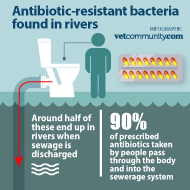
Ninety per cent of antibiotics taken by people enter the sewage system after passing through the body, with around half ending up in rivers when the sewage is discharged. 


“The release of drugs and bugs into our rivers increases the likelihood of antibiotic-resistant genes being shared, either through mutation or ‘bacterial sex’,” explains Dr Singer.

“This is the first step towards the development of superbugs as the drugs used to fight them will no longer work. Environmental pollution from drugs and bugs is a serious problem that we need to find solutions to.”


Researchers say there are several possible solutions to cut the number of antibiotics that enter our rivers. These include reducing inappropriate prescriptions, taking preventative action so fewer medicines are needed in the first place and increased investment in the research and development of new wastewater treatment processes. 

Become a member or log in to add this story to your CPD history

Equine Disease Surveillance report released for Q4 2025

News Story 1
 The latest Equine Disease Surveillance report has been released, with details on equine disease from Q4 of 2025.

The report, produced by Equine Infectious Disease Surveillance, includes advice on rule changes for equine influenza vaccination.

Statistics and maps detail recent outbreaks of equine herpes virus, equine influenza, equine strangles and equine grass sickness. A series of laboratory reports provides data on virology, bacteriology, parasitology and toxicosis.

This issue also features a case study of orthoflavivus-associated neurological disease in a horse in the UK. 

Click here for more...
News Shorts
RCVS members invited to question Council candidates

RCVS members have been invited to submit questions to candidates for this year's RCVS Council election.

With 15 candidates standing for three available positions, vets have been invited to submit a question of their choosing before voting starts. These questions will be collated, with each candidate answering one question of their choice.

It is recommended that members read the candidates' biographies and statements before submitting questions. One question per member can be submitted to vetvote26@rcvs.org.uk before Wednesday, 25 February 2026.

The RCVS Council election is due to start in March.

With only two candidates for two positions on the VN Council, there will be no VN Council elections this year. Meghan Conroy RVN and Lauren Hargrave RVN will begin their three year terms at RCVS' AGM in July.