Your data on MRCVSonline
The nature of the services provided by Vision Media means that we might obtain certain information about you.
Please read our Data Protection and Privacy Policy for details.

In addition, (with your consent) some parts of our website may store a 'cookie' in your browser for the purposes of
functionality or performance monitoring.
Click here to manage your settings.
If you would like to forward this story on to a friend, simply fill in the form below and click send.

Your friend's email:
Your email:
Your name:
 
 
Send Cancel

Cetacean strandings on the rise in the UK
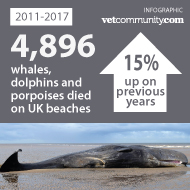
Infectious disease and incidental entanglement in fishing gear were among the most common causes of death.
Stranding events peaked in 2017, report finds 

Marine mammal strandings are on the rise in the UK, according to new figures, which reveal infectious disease and bycatch are among the most common causes.

A review by the UK government and the Zoological Society of London (ZSL) shows that 4,896 harbour porpoises, dolphins and whales were reported washed up on UK shorelines from 2011-2017.

This is an increase of 15 per cent compared to the previous seven-year period. Over 1,000 strandings were reported in 2017 alone, the highest number of stranding events in a single year since records began in 1990.

Cetologist and report lead Rob Deaville explained: “It’s difficult to say conclusively what’s driven this rise, but it’s potentially associated with multiple causes, including increases in local reporting effort and seasonal variation in the population density of some species.”

Researchers also carried out 1,030 post mortems during the report period. Infectious disease and incidental entanglement in fishing gear were among the most common causes of death. However, the likelihood of particular causes of death varied between species.

Other deaths caused directly by human activity included 25 animals killed by ship-strike and a single Cuvier’s beaked whale that suffered gastric impaction after ingesting marine litter in 2015.

However, Mr Deaville said the total proportion of deaths linked to human activity is likely to be much higher than the report shows. Whilst researchers can readily diagnose causes such as ship-strike, which causes characteristic injuries, less direct causes of death can be more difficult to identify.

“For example, cases of infectious disease may be associated with exposure to chemical pollution, including legacy pollutants such as PCBs (polychlorinated biphenyls), which can have immunosuppressive effects,” he added.

Whilst aspects of the report paint a “bleak picture”, Mr Deaville said there are still positives. Researchers recorded 21 cetacean species, including the dwarf sperm whale which had never previously been seen in the UK. 

Become a member or log in to add this story to your CPD history

Equine Disease Surveillance report released for Q4 2025

News Story 1
 The latest Equine Disease Surveillance report has been released, with details on equine disease from Q4 of 2025.

The report, produced by Equine Infectious Disease Surveillance, includes advice on rule changes for equine influenza vaccination.

Statistics and maps detail recent outbreaks of equine herpes virus, equine influenza, equine strangles and equine grass sickness. A series of laboratory reports provides data on virology, bacteriology, parasitology and toxicosis.

This issue also features a case study of orthoflavivus-associated neurological disease in a horse in the UK. 

Click here for more...
News Shorts
NSA webinar explores sheep tailing and castration

The National Sheep Association (NSA) is to host a free webinar on the castration and tail docking of lambs.

The webinar, 'Understanding the tailing and castration consultation: A guide for sheep farmers', will be hosted online on Monday, 2 March 2026 at 7.30pm.

It comes during a government consultation into the methods used for these procedures. Farmers are encouraged to engage before the consultation period closes on Monday, 9 March 2026.

The webinar offers clear and actionable guidance to support farmers to contribute meaningfully to the consultation and prepare for potential changes.

On the panel will be former SVS president Kate Hovers, farmer and vet Ann Van Eetvelt and SRUC professor in Animal Health and Veterinary Sciences Cathy Dwyer. Each panel member will utilise their own specialism and expertise to evaluate risks and outcomes to sheep farming.

Find out more about the webinar on the NSA website.